- +1 (602) 922-5990
-
This email address is being protected from spambots. You need JavaScript enabled to view it. - Mon - Fri 8:00a - 5:00p AZ






-

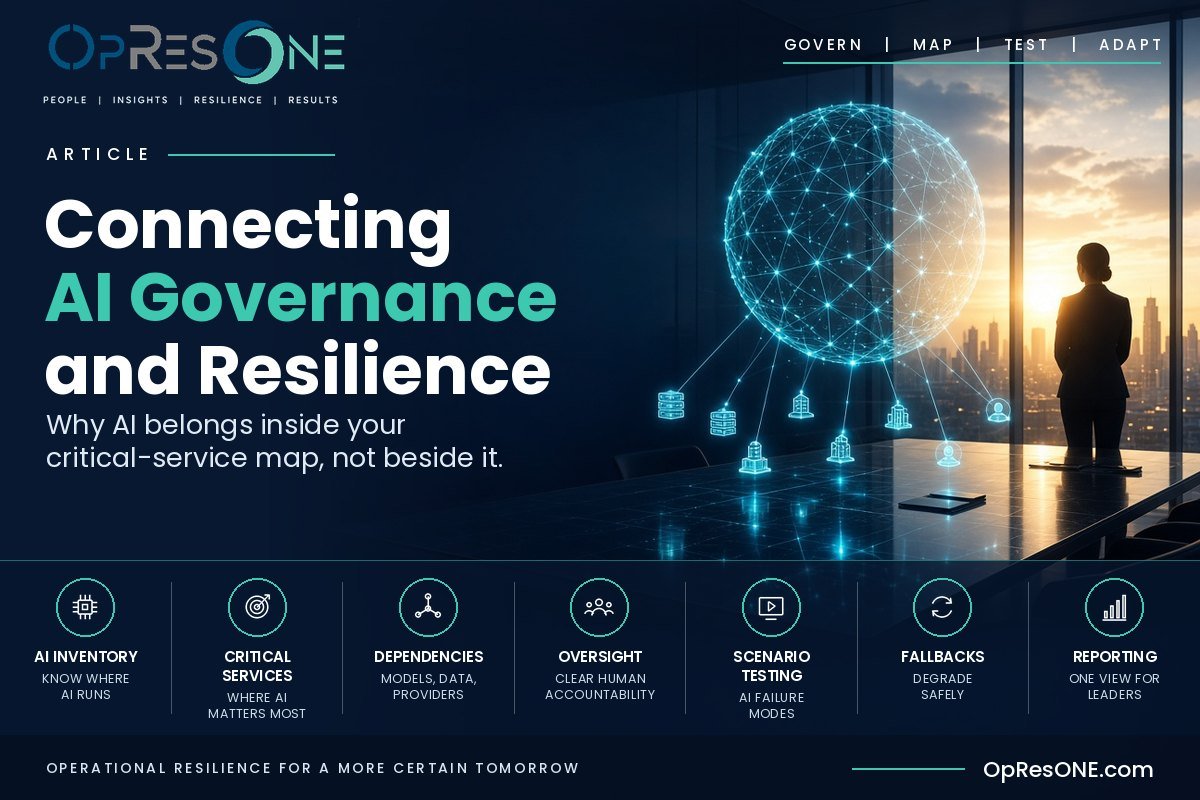
Many organizations now run two important programs side by side without connecting them. One is AI governance: the policies, committees, and risk assessments that decide how artificial intelligence may be developed, bought, and used. The other is operational resilience: the discipline of keeping critical services running through disruption. They are often staffed by different people, report to different executives, and use different vocabularies.
That separation made sense when AI sat at the edges of the business, in pilots and productivity tools. It makes less sense now that AI models help route customer calls, flag fraud, schedule maintenance, draft communications, and prioritize work queues. When AI becomes part of how a critical service is delivered, its failure becomes a resilience problem, and resilience planning that ignores it has a blind spot.
This article explains why the two disciplines need each other and how leaders can connect them without building another layer of bureaucracy.
-
"There will be a human in the loop." It is one of the most common reassurances offered when organizations deploy artificial intelligence, and one of the least examined. A person somewhere in the process is expected to catch errors, prevent harm, and take responsibility. Yet in practice, that person may be reviewing hundreds of AI recommendations an hour, may lack the information to judge them, may have no real authority to overrule them, and may have learned through experience that the AI is usually right.
In those conditions, human oversight becomes a formality. The human signs off, the AI effectively decides, and accountability becomes harder to locate when something goes wrong.
Meaningful oversight is achievable, but it has to be designed. This article explains how to define review and intervention points that work: where to place them, what the people in them need, and how to know whether oversight is real.
-
Over the past several years, many organizations have published statements of AI principles. They commit to fairness, transparency, privacy, safety, and human oversight. These statements are a reasonable starting point. They signal intent to employees, customers, and regulators, and they give teams a shared vocabulary.
But principles do not govern anything on their own. A commitment to fairness does not tell a product team which tests to run before launching a credit model. A commitment to transparency does not say who decides what customers are told when AI is involved in a decision. A commitment to human oversight does not specify who can stop a system that is behaving badly. Between the principle and the practice sits a gap, and that gap is filled either by deliberate accountability or by assumptions.
This article explains how to turn AI principles into practical accountability that works across the full lifecycle of AI systems, from the first idea to retirement.
-
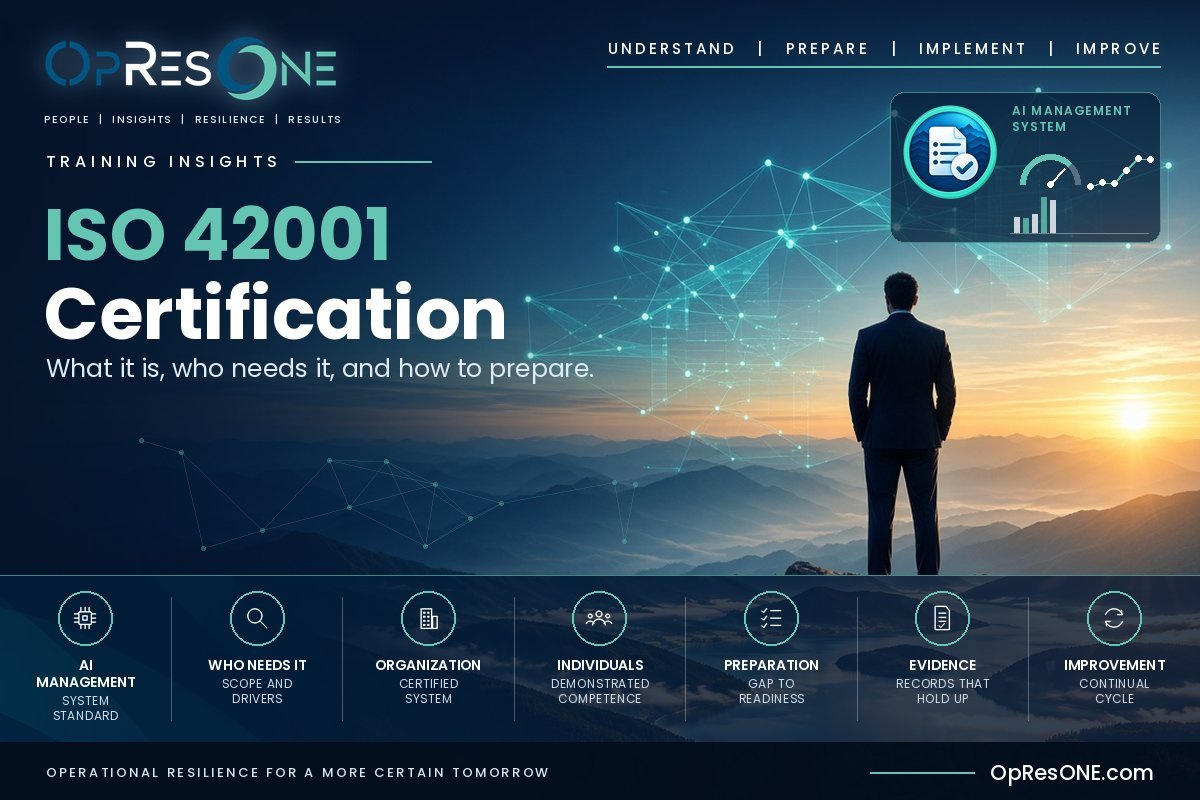
ISO/IEC 42001:2023, Information technology — Artificial intelligence — Management system, is the international standard for an artificial intelligence management system (AIMS). ISO published the first edition in December 2023. It specifies requirements, and provides guidance, for establishing, implementing, maintaining and continually improving an AIMS, and is intended for any organization that provides or uses products or services that utilize AI systems.
This article explains what ISO 42001 certification is, who typically needs it, how individual competence — including implementer and auditor roles — differs from organizational certification, and how to prepare. It draws on ISO's published pages and on the published structure of the standard. OpResONE has no affiliation with ISO. This article is not an official interpretation of the standard, and it is not a substitute for a licensed copy.
-
Organizations want their customers, employees, regulators, and boards to trust the AI systems they use. Trust, however, cannot be requested. It has to be earned, and in a governance context it is earned through evidence: documented, verifiable information showing that an AI system was designed responsibly, tested appropriately, operates as intended, and is overseen effectively.
Many organizations have pieces of that evidence. A data science team has validation results. A vendor has supplied a technical summary. A risk team has completed an impact assessment. A monitoring dashboard tracks some performance metrics. But the pieces often sit in different places, follow different standards, and stop at the moment of deployment. When someone asks a direct question, such as "How do we know this model is still performing fairly?", assembling an answer takes weeks, if it can be done at all.
This article sets out how to connect testing, monitoring, and assurance into a continuous chain of evidence that supports trust in AI over its full life.