






Risk Management
Are you reacting to risk, or steering it?
Identify, assess, quantify and report to the board. The SwissGRC GRC Toolbox is built so risk management can support decisions, using both qualitative and quantitative methods.
OpResONE is an Authorized SwissGRC Channel Partner.
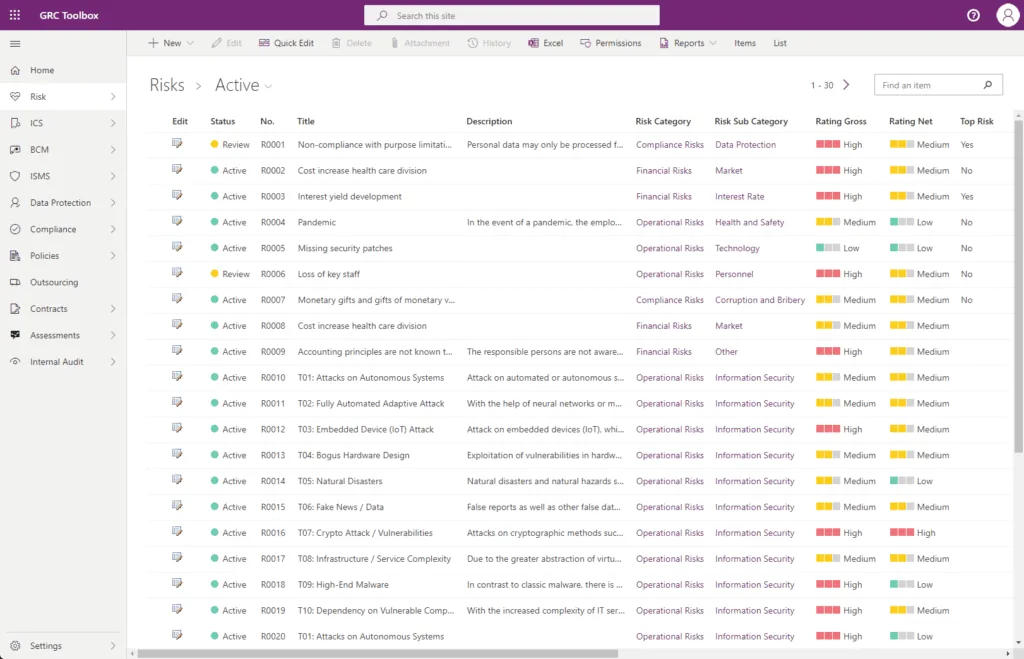
From a risk register to effective steering
Registers, assessments and controls are familiar. What sets programs apart is how well they work together.
Solid building blocks, separate systems
When risks, controls and events live in separate tools, the overall picture arrives late and has to be assembled by hand.
- Risks, controls and incidents in separate tools
- The overall picture is assembled manually in reporting
- Dependencies are hard to trace
- How current the data is depends on individuals
Risks connected and under control
Risks stay linked to controls, events and actions, across risk types, organization-wide or in a single domain. The picture stays consistent, and decisions can be backed by evidence.
- Identification, assessment and reporting in one place
- Controls and incidents linked directly to the risk
- Integrated with internal controls, compliance, security and continuity
- Simulation can support assessments that have to hold up in the boardroom
Your risk management, in one place
Identify, assess, monitor, treat and report from connected views.
Every risk in view
All risk types in one structure: status, category, gross and net rating, and top risks side by side, ready to prioritize.
Structured assessment
Assess qualitatively or quantitatively. Self-assessment and control testing can show control effectiveness, with gross and net positions in one matrix, including ESG where you use it.
Incidents and losses on the risk
Record events and loss data on the related risk, with the cause-and-effect chain and the actions that follow.
Actions with owners and dates
Every action has a named owner and a due date. Progress and deadlines stay visible from assignment to closure.
Reporting the board can use
An aggregated view of risk against risk-bearing capacity, and whether the organization stays within its risk appetite, including value-at-risk views where you use them.
From a rating to a number
Where a qualitative rating stops, the platform can keep going: likelihood and impact can be turned into a number you can defend. RiskQuant is the quantification module.
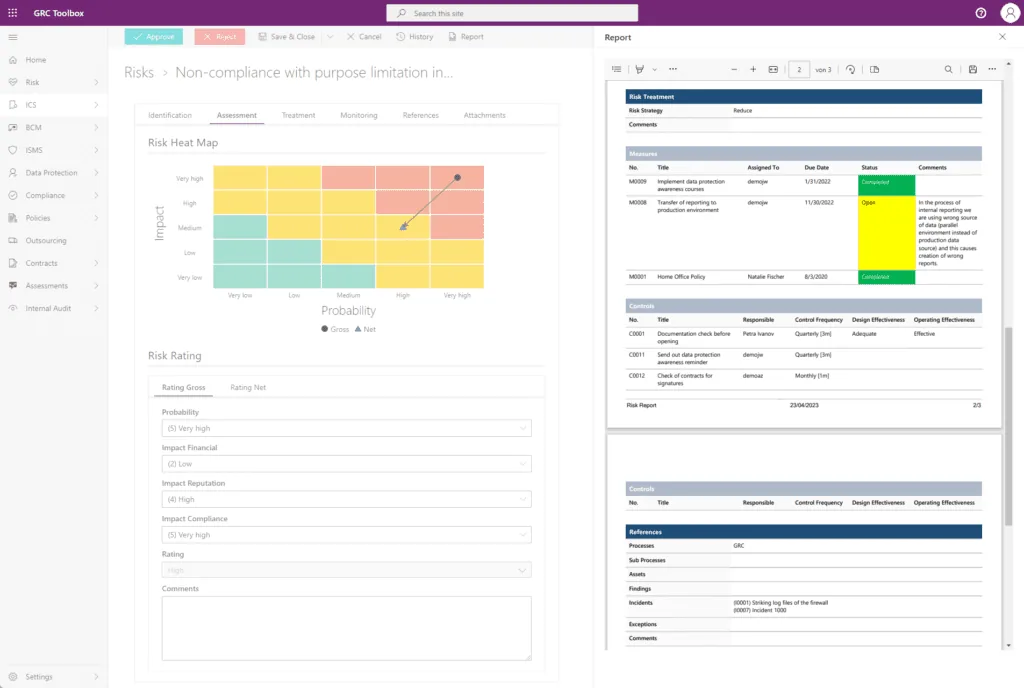
Assess risks and controls together
A risk matrix can show gross and net positions. Risk control self-assessment and control testing sit with the risk, and assessment criteria can be defined to match your method.
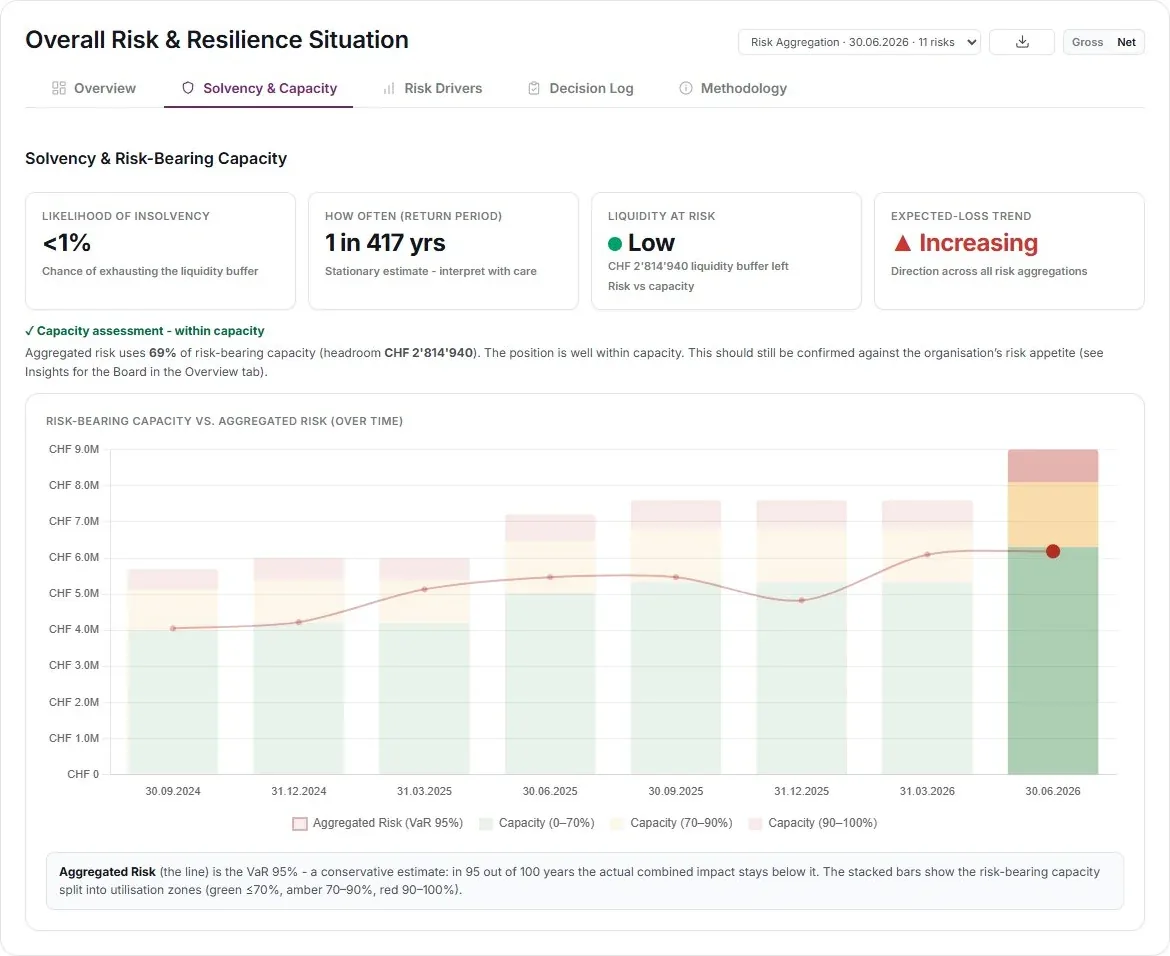
A picture the board can use
Report aggregated risk against risk-bearing capacity and appetite, instead of building that view in a spreadsheet the night before the meeting.
More control, better decisions
The module is designed to be comprehensive without being hard to use, so people will actually work in it.
All corporate risks
Enterprise, operational, IT and cyber, or compliance risk can sit in one solution, across the organization or in a single domain.
Part of a connected GRC system
Risk management can share a foundation with internal controls, information security, continuity, compliance, data protection and third-party risk.
Risk and opportunity together
Opportunities can be captured and assessed as well as downside risk.
A stronger risk culture
Workflows can involve the responsible owners in everyday work, not only at reporting time.
A consistent method
The source describes a consistent, automated approach that can be aligned with ISO 31000 and COSO ERM. Naming a standard does not mean your program is certified.
Better decisions
A consolidated view of the risk situation, qualitative and quantitative, that can travel as far as the board.
See the platform on your own risk landscape
In a demo we will walk through the SwissGRC GRC Toolbox using your topics and questions. If you also want a managed risk and GRC program, we can talk about GRC as a Service.


