- +1 (602) 922-5990
-
This email address is being protected from spambots. You need JavaScript enabled to view it. - Mon - Fri 8:00a - 5:00p AZ






-

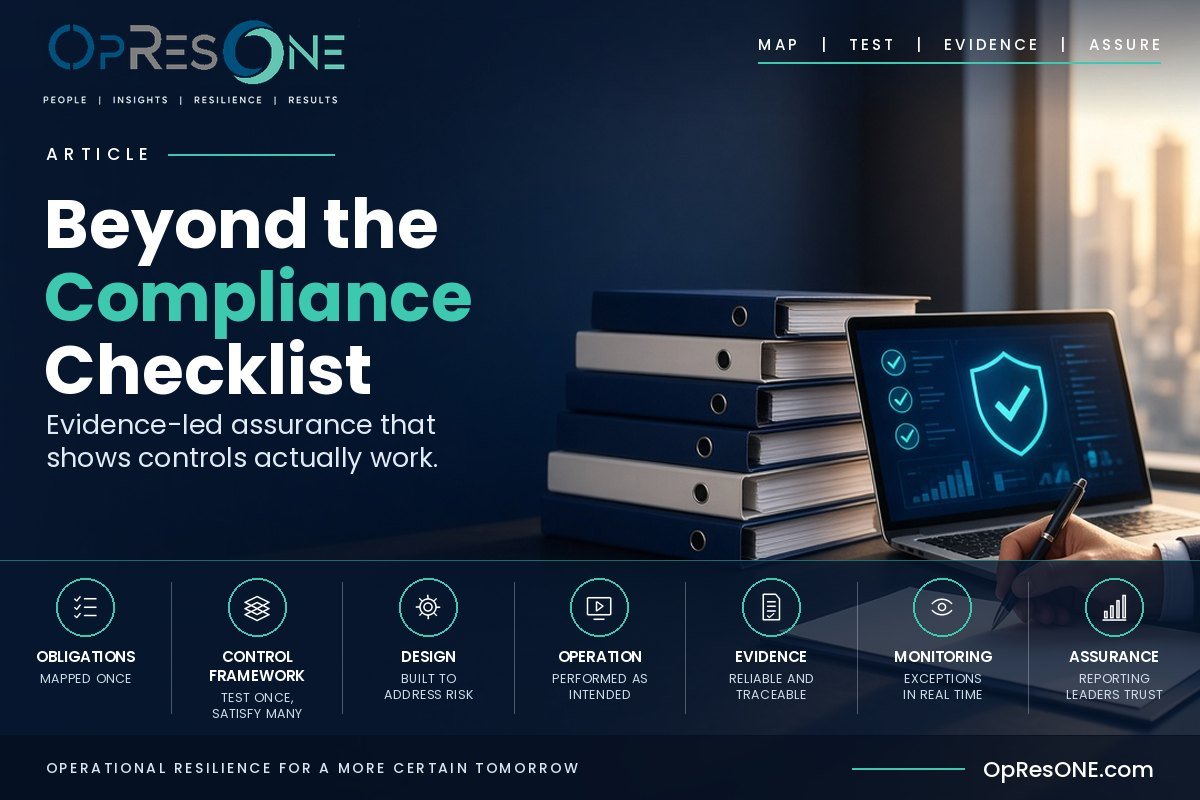 Every compliance program eventually produces a checklist. Requirements are listed, controls are mapped, owners tick boxes, and the audit file fills up. The checklist is useful, but it answers a narrow question: did we do what we said we would do? It rarely answers the question executives, auditors, regulators, and customers increasingly ask: how do you know your controls actually work?
This article explains how to move from checklist compliance to evidence-led control assurance, an approach that tests whether controls are well designed and operating effectively, and that produces evidence strong enough to rely on. It is written for compliance leaders, internal auditors, and the control owners who carry the day-to-day load.
-
Every resilience professional has seen it: an exercise surfaces a serious weakness, the debrief is lively, a report is written, and a year later the next exercise surfaces the same weakness. The contact list is still out of date. The escalation path is still unclear. The manual workaround still depends on one person who knows how it works. The lesson was identified, but it was never learned.
Exercises and real incidents are only as valuable as the changes they produce. Turning findings into lasting improvement requires a disciplined process: understanding why something went wrong, assigning clear ownership, defining what "fixed" means, and then proving the fix through retesting. Without that discipline, an exercise program becomes an expensive way to rediscover known problems.
This article sets out a practical approach to closing the loop, from the moment an exercise ends to the point where the organization can show that it is measurably more ready.
-
Organizations want their customers, employees, regulators, and boards to trust the AI systems they use. Trust, however, cannot be requested. It has to be earned, and in a governance context it is earned through evidence: documented, verifiable information showing that an AI system was designed responsibly, tested appropriately, operates as intended, and is overseen effectively.
Many organizations have pieces of that evidence. A data science team has validation results. A vendor has supplied a technical summary. A risk team has completed an impact assessment. A monitoring dashboard tracks some performance metrics. But the pieces often sit in different places, follow different standards, and stop at the moment of deployment. When someone asks a direct question, such as "How do we know this model is still performing fairly?", assembling an answer takes weeks, if it can be done at all.
This article sets out how to connect testing, monitoring, and assurance into a continuous chain of evidence that supports trust in AI over its full life.


