- +1 (602) 922-5990
-
This email address is being protected from spambots. You need JavaScript enabled to view it. - Mon - Fri 8:00a - 5:00p AZ






-

During a major outage, recovery teams rarely fail because they do not know how to restore a system. They struggle because they do not know what that system needs before it can work, what else depends on it, and therefore what must come back first. An application restored ahead of the database it needs will not start. A database restored before the identity service that controls access cannot be used. A service brought back without the interface to a key partner may run but deliver nothing of value.
Dependency mapping is how organizations answer those questions before a disruption, rather than discovering the answers in the middle of one. This article explains what to map, how to turn maps into a recovery sequence, and how to keep them current. It is written for IT disaster recovery professionals, CIOs, and the business continuity teams who rely on accurate recovery plans.
-
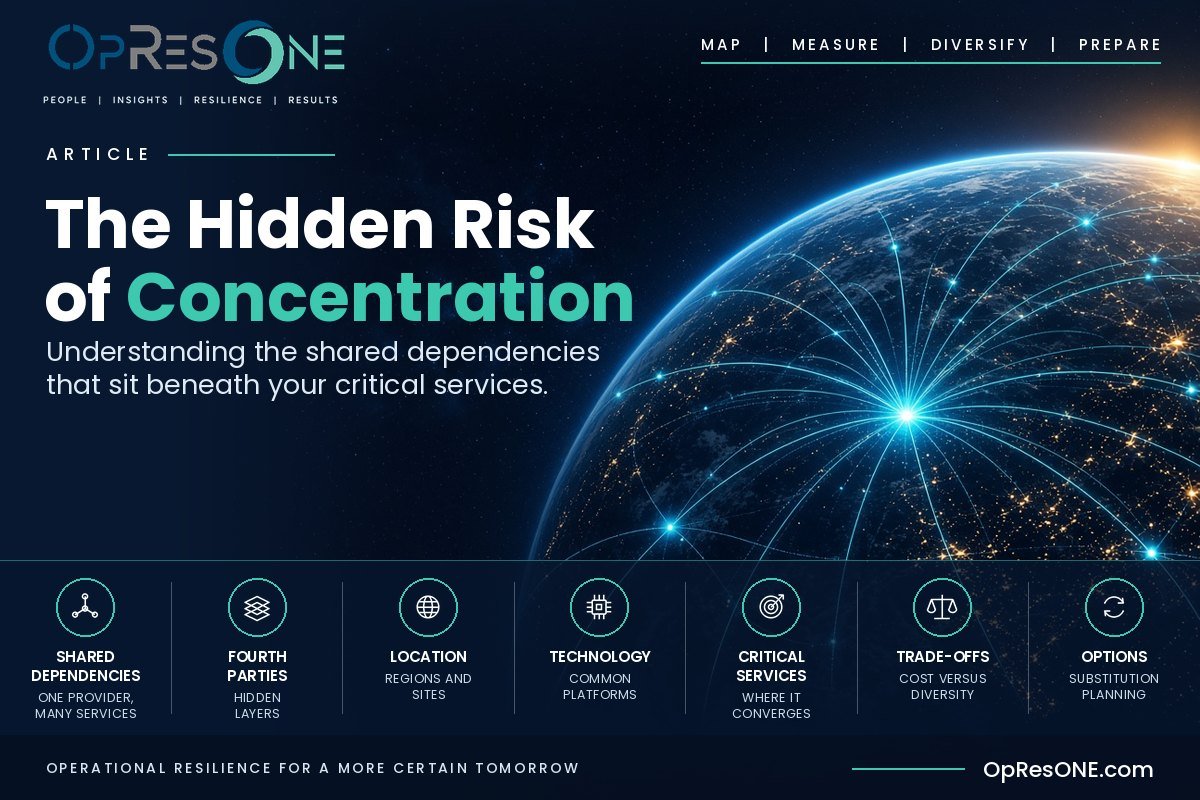
Risk registers tend to list risks one at a time. A supplier might fail. A system might go down. A site might become unavailable. Each risk is assessed, given an owner, and managed. What these lists often miss is the way dependencies overlap. When several critical services rely on the same provider, the same software platform, the same data center region, or the same small team, a single disruption does not affect one service. It affects many at once.
This is concentration risk, and it is one of the least visible exposures in modern operations. It builds gradually, through sensible individual decisions: standardizing on a leading cloud provider, consolidating vendors to reduce cost, adopting a widely used security tool, centralizing expertise in a shared service. Each decision makes sense on its own. Together, they can create a point where one failure reaches across the organization.
This brief explains how concentration risk arises, how to make it visible, and how leaders can decide what to do about it.