- +1 (602) 922-5990
-
This email address is being protected from spambots. You need JavaScript enabled to view it. - Mon - Fri 8:00a - 5:00p AZ






-

Most organizations have a process for vetting suppliers. Before signing a contract, a provider completes a questionnaire, submits policies and certificates, and perhaps shares a summary of its business continuity plan. Procurement and risk teams review the responses, score the provider, and file the results. The relationship begins, and the file is revisited at renewal.
That process has value. It screens out providers with obvious weaknesses and creates a record of what was promised. But it rarely answers the question that matters most when a critical provider is disrupted: can this provider actually keep delivering, or recover quickly enough, to keep our critical services within acceptable limits? A questionnaire records what a provider says it can do. Resilience depends on what it can demonstrate.
This article explains how to move beyond paper-based due diligence toward evidence that critical providers can withstand and recover from disruption.
-
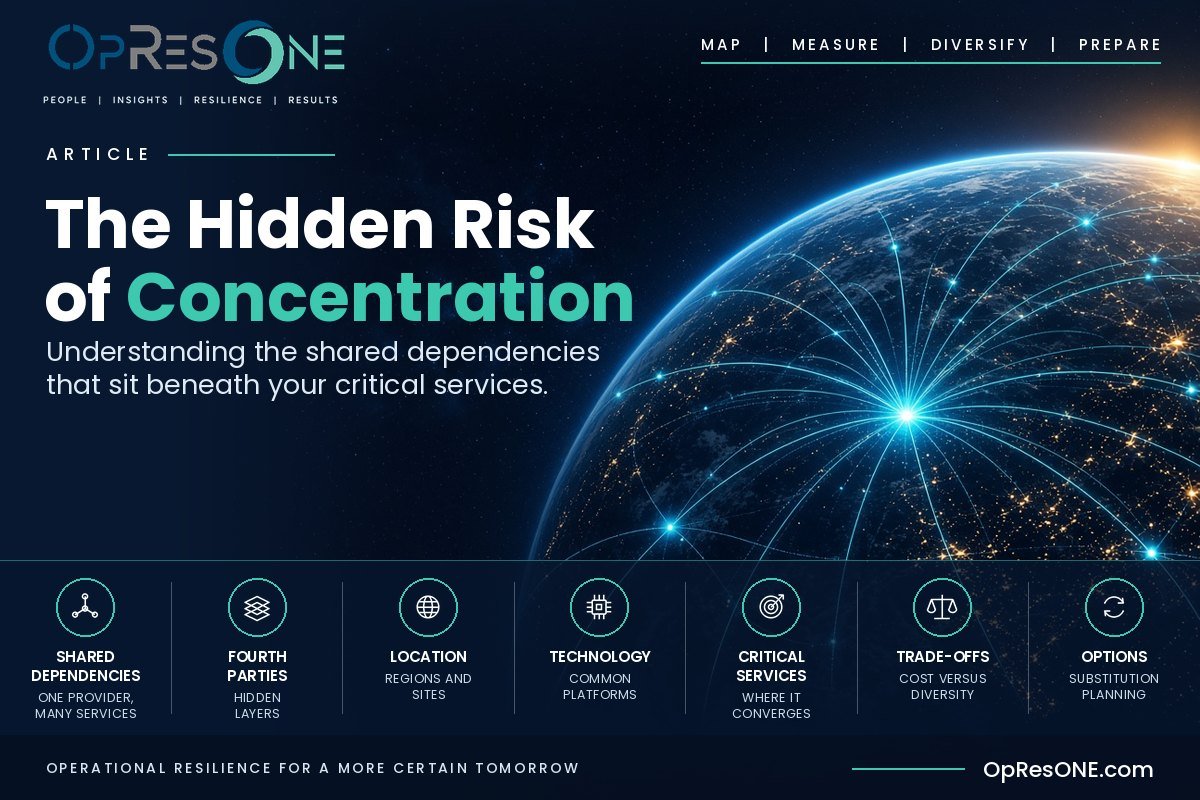
Risk registers tend to list risks one at a time. A supplier might fail. A system might go down. A site might become unavailable. Each risk is assessed, given an owner, and managed. What these lists often miss is the way dependencies overlap. When several critical services rely on the same provider, the same software platform, the same data center region, or the same small team, a single disruption does not affect one service. It affects many at once.
This is concentration risk, and it is one of the least visible exposures in modern operations. It builds gradually, through sensible individual decisions: standardizing on a leading cloud provider, consolidating vendors to reduce cost, adopting a widely used security tool, centralizing expertise in a shared service. Each decision makes sense on its own. Together, they can create a point where one failure reaches across the organization.
This brief explains how concentration risk arises, how to make it visible, and how leaders can decide what to do about it.
-
Most third-party contingency planning rests on a quiet assumption: the provider will come back. Business continuity plans describe how to operate while a supplier restores its service. Contracts specify recovery time objectives. Exercises rehearse the hours or days until normal operations resume. That assumption is usually right. But sometimes it is not.
Providers can become insolvent. They can be acquired and decide to discontinue a product. They can suffer a destructive cyberattack from which certain systems cannot be restored. They can be subject to sanctions, legal action, or regulatory intervention that stops them from serving you. They can simply withdraw from a market. In these situations, waiting for recovery is not a strategy. The organization needs a way to keep its critical services running without that provider, possibly for a long time, possibly permanently.
This article explains how to prepare for the case where a critical provider cannot recover, and how to build alternatives that work before they are needed.