- +1 (602) 922-5990
-
This email address is being protected from spambots. You need JavaScript enabled to view it. - Mon - Fri 8:00a - 5:00p AZ






-

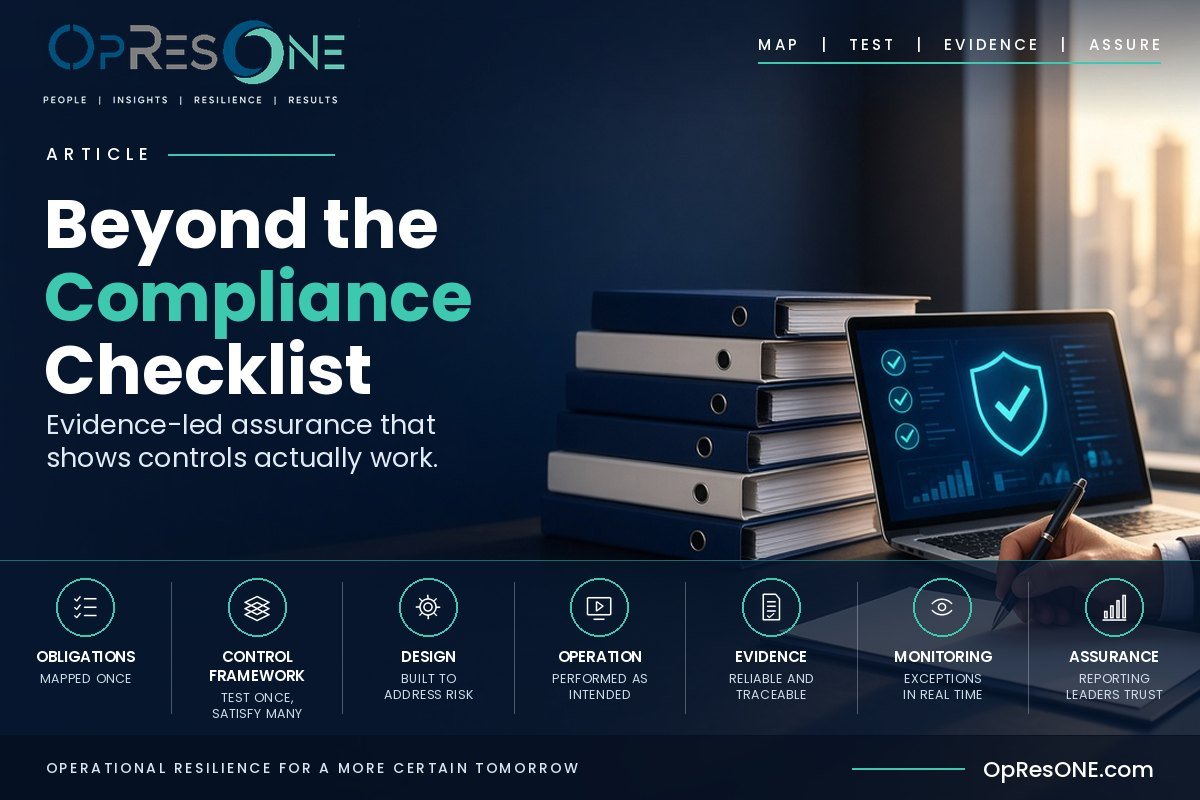 Every compliance program eventually produces a checklist. Requirements are listed, controls are mapped, owners tick boxes, and the audit file fills up. The checklist is useful, but it answers a narrow question: did we do what we said we would do? It rarely answers the question executives, auditors, regulators, and customers increasingly ask: how do you know your controls actually work?
This article explains how to move from checklist compliance to evidence-led control assurance, an approach that tests whether controls are well designed and operating effectively, and that produces evidence strong enough to rely on. It is written for compliance leaders, internal auditors, and the control owners who carry the day-to-day load.
-
When ransomware strikes, the first question many executives ask is, "Do we have backups?" It is a reasonable question, but it is not the most important one. The harder questions are whether those backups are intact, whether they are free of the attacker's tools, which point in time can be trusted, what must be rebuilt before anything can be restored, and how the organization will know a restored system is safe to reconnect.
Clean restoration needs more than backups. It requires a recovery capability designed for an adversary who may have been inside the environment for some time, may have targeted backup systems deliberately, and may try to return. This article explains what that capability involves and how organizations can prepare for it. It is written for CIOs, CISOs, and the infrastructure and recovery leaders who would carry out the work.
-
Most organizations test their technology. They run vulnerability scans, penetration tests, backup restores, and failover drills. Far fewer test the decisions that determine how a serious cyber incident unfolds: when to disconnect a business unit, whether to take a customer-facing service offline, who determines whether an incident is material, what to tell customers and regulators, and when it is safe to resume. Those decisions are made by executives, often with incomplete information and under intense time pressure. When they have never been rehearsed, even a strong technical response can be undermined by delay, confusion, or conflicting instructions.
This article explains how to design exercises that connect technical response with executive action, so that leaders practice the decisions that matter before they face them for real. It is written for CISOs, crisis and continuity leaders, and the executives who would sit at the table.
-
During a major outage, recovery teams rarely fail because they do not know how to restore a system. They struggle because they do not know what that system needs before it can work, what else depends on it, and therefore what must come back first. An application restored ahead of the database it needs will not start. A database restored before the identity service that controls access cannot be used. A service brought back without the interface to a key partner may run but deliver nothing of value.
Dependency mapping is how organizations answer those questions before a disruption, rather than discovering the answers in the middle of one. This article explains what to map, how to turn maps into a recovery sequence, and how to keep them current. It is written for IT disaster recovery professionals, CIOs, and the business continuity teams who rely on accurate recovery plans.
-
Many disaster recovery tests end with a report that says "passed." Every task on the test plan was completed: servers were failed over, databases were restored, applications started, and the checklist was signed. Yet a closer look often reveals that the test measured whether steps were carried out, not whether the business could operate again within the time and data loss it can tolerate. A recovery plan can be executed flawlessly and still leave the organization unready.
This article explains how to move from recovery plans that are documented and periodically exercised to tested readiness: a state in which the organization has current evidence that critical services can be recovered to agreed outcomes, and a program that keeps that evidence current. It is written for IT disaster recovery professionals, CIOs, and the continuity and risk leaders who oversee recovery capability.
-
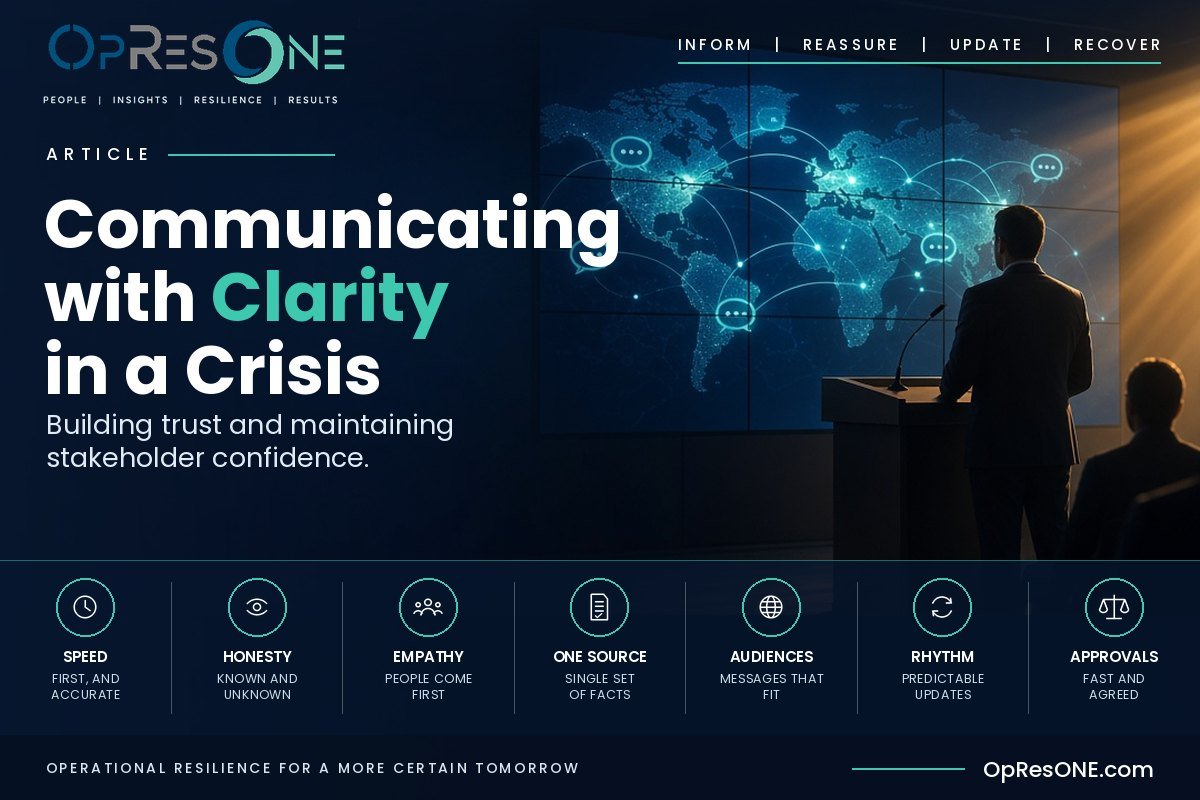
In a crisis, communication is not a supporting activity. It is part of the response. What an organization says, when it says it, and how consistently it speaks shape how employees act, how customers respond, how regulators judge the organization's control of the situation, and how the public interprets events. Organizations that communicate clearly can maintain trust even when the news is bad. Organizations that go silent, speculate, or contradict themselves can lose trust even when their operational response is sound.
This article explains how to build crisis communication capability that earns and keeps stakeholder confidence. It covers the principles that matter most, the practical structures that make them work under pressure, and the preparation leaders can do now. It is written for executives, communications leaders, and the business continuity and crisis professionals who support them.
-
Most leaders do not need to be persuaded that disruption is coming. They have lived through cloud outages, ransomware attacks on suppliers, staffing shocks, and severe weather that closed sites without warning. The harder question is practical: where do you begin when "operational resilience" seems to touch every function, every system, and every contract at once?
The answer is to start narrow and deliberate. Operational resilience is the ability to keep delivering the services that matter most when something goes wrong, and to stay within limits the organization has decided it can accept. That definition gives you a starting point. You do not begin with every risk, every asset, or every plan. You begin with a short list of services, the harm that would follow if they stopped, and the people accountable for them. Everything else builds from there.
This article sets out a practical sequence for the first twelve months, written for executives and the resilience leaders who support them.
-
Every resilience professional has seen it: an exercise surfaces a serious weakness, the debrief is lively, a report is written, and a year later the next exercise surfaces the same weakness. The contact list is still out of date. The escalation path is still unclear. The manual workaround still depends on one person who knows how it works. The lesson was identified, but it was never learned.
Exercises and real incidents are only as valuable as the changes they produce. Turning findings into lasting improvement requires a disciplined process: understanding why something went wrong, assigning clear ownership, defining what "fixed" means, and then proving the fix through retesting. Without that discipline, an exercise program becomes an expensive way to rediscover known problems.
This article sets out a practical approach to closing the loop, from the moment an exercise ends to the point where the organization can show that it is measurably more ready.
-
The tabletop exercise is the workhorse of continuity and crisis programs, and for good reason. It is inexpensive, it brings the right people into one room, and it can surface gaps in roles, communication, and decision-making without disrupting operations. But many tabletop exercises share a quiet flaw: they are built to walk through the plan rather than to test it. The scenario unfolds the way the plan expects, participants describe what they would do, the facilitator nods, and everyone leaves reassured.
Reassurance is not the goal. The purpose of an exercise is to find out what is not true before a real event does. That requires deliberate design: clear objectives, explicit assumptions to challenge, scenarios that create genuine pressure, and an evaluation method that captures evidence rather than impressions.
This article sets out how to design exercises that go beyond the tabletop, whether you keep the discussion-based format or move toward more operational testing.
-
"There will be a human in the loop." It is one of the most common reassurances offered when organizations deploy artificial intelligence, and one of the least examined. A person somewhere in the process is expected to catch errors, prevent harm, and take responsibility. Yet in practice, that person may be reviewing hundreds of AI recommendations an hour, may lack the information to judge them, may have no real authority to overrule them, and may have learned through experience that the AI is usually right.
In those conditions, human oversight becomes a formality. The human signs off, the AI effectively decides, and accountability becomes harder to locate when something goes wrong.
Meaningful oversight is achievable, but it has to be designed. This article explains how to define review and intervention points that work: where to place them, what the people in them need, and how to know whether oversight is real.
-
Most third-party contingency planning rests on a quiet assumption: the provider will come back. Business continuity plans describe how to operate while a supplier restores its service. Contracts specify recovery time objectives. Exercises rehearse the hours or days until normal operations resume. That assumption is usually right. But sometimes it is not.
Providers can become insolvent. They can be acquired and decide to discontinue a product. They can suffer a destructive cyberattack from which certain systems cannot be restored. They can be subject to sanctions, legal action, or regulatory intervention that stops them from serving you. They can simply withdraw from a market. In these situations, waiting for recovery is not a strategy. The organization needs a way to keep its critical services running without that provider, possibly for a long time, possibly permanently.
This article explains how to prepare for the case where a critical provider cannot recover, and how to build alternatives that work before they are needed.
-
An operational resilience program depends on more than a policy and a set of documents. It depends on people who can identify important business services, set impact tolerances, map the resources those services need, and test the organization's ability to stay within those tolerances when something goes wrong. If only a small team understands those tasks, the program will stall the first time a service owner, a technology lead or a senior manager has to make a decision the documents do not already answer.
This article explains the skills an operational resilience program needs, and how operational resilience training supports that work. It uses the language of important business services, impact tolerances, mapping and scenario testing as it appears in the United Kingdom's operational resilience framework, and it notes how similar ideas show up in other regimes without treating those regimes as identical. OpResONE has no affiliation with the Financial Conduct Authority (FCA), the Prudential Regulation Authority (PRA) or the Federal Financial Institutions Examination Council (FFIEC). This article is not an official interpretation of their publications.