- +1 (602) 922-5990
-
This email address is being protected from spambots. You need JavaScript enabled to view it. - Mon - Fri 8:00a - 5:00p AZ






-

For years, cybersecurity strategy has been framed largely as a contest of prevention: stronger perimeters, better detection, fewer vulnerabilities. That work remains essential. But prevention alone cannot be the whole strategy, because no organization can guarantee that every attack will be stopped. The more useful question for executives is not only "How do we keep attackers out?" but "When something gets through, can we keep delivering the services that matter most, and recover them with confidence?"
That question is the heart of cyber resilience. This article explains what it means in practice, why it requires a business-led view rather than a purely technical one, and how organizations can prepare critical services to withstand cyber disruption. It is written for CISOs, CIOs, and the executives they brief.
-
During a major outage, recovery teams rarely fail because they do not know how to restore a system. They struggle because they do not know what that system needs before it can work, what else depends on it, and therefore what must come back first. An application restored ahead of the database it needs will not start. A database restored before the identity service that controls access cannot be used. A service brought back without the interface to a key partner may run but deliver nothing of value.
Dependency mapping is how organizations answer those questions before a disruption, rather than discovering the answers in the middle of one. This article explains what to map, how to turn maps into a recovery sequence, and how to keep them current. It is written for IT disaster recovery professionals, CIOs, and the business continuity teams who rely on accurate recovery plans.
-
Most leaders do not need to be persuaded that disruption is coming. They have lived through cloud outages, ransomware attacks on suppliers, staffing shocks, and severe weather that closed sites without warning. The harder question is practical: where do you begin when "operational resilience" seems to touch every function, every system, and every contract at once?
The answer is to start narrow and deliberate. Operational resilience is the ability to keep delivering the services that matter most when something goes wrong, and to stay within limits the organization has decided it can accept. That definition gives you a starting point. You do not begin with every risk, every asset, or every plan. You begin with a short list of services, the harm that would follow if they stopped, and the people accountable for them. Everything else builds from there.
This article sets out a practical sequence for the first twelve months, written for executives and the resilience leaders who support them.
-
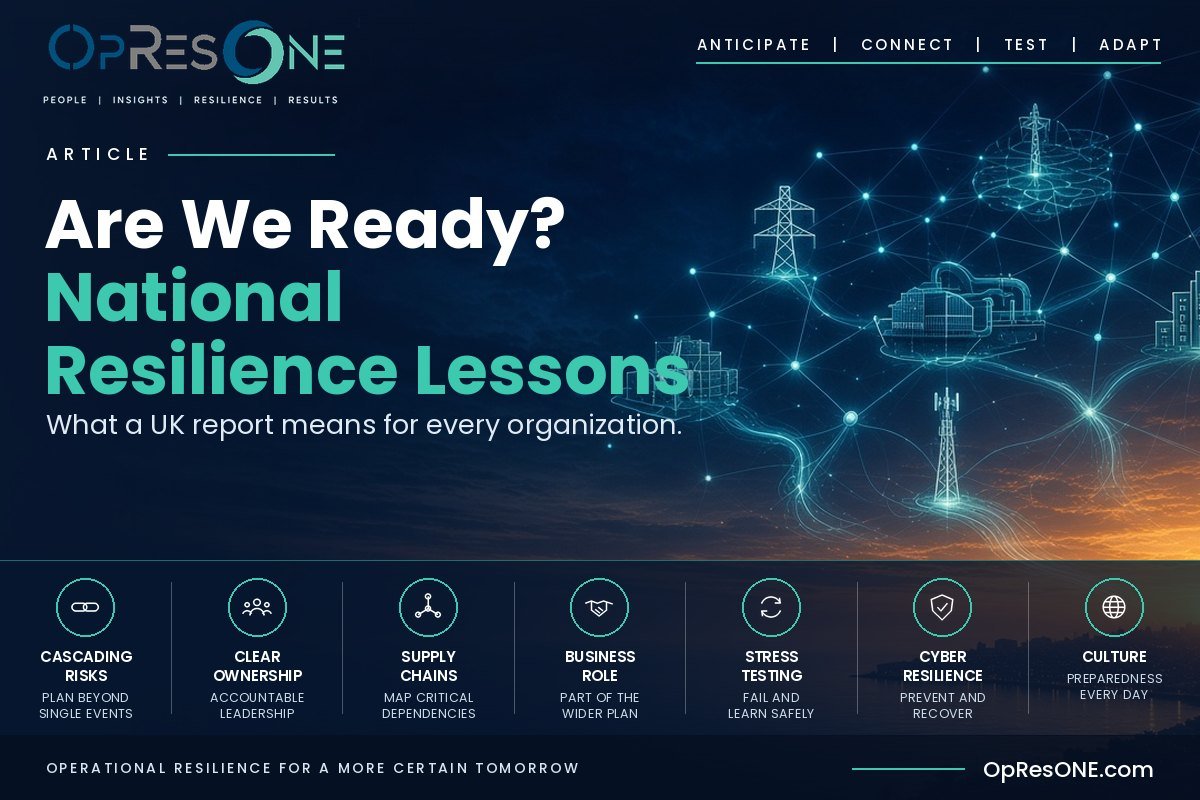
On 16 November 2026, the UK House of Lords National Resilience Committee published its report, Are we ready? Building a culture of resilience (HL Paper 79). Its conclusion is blunt. In the Committee's words, the UK is "seriously underprepared" for the growing and interconnected risks it faces, and the Government must act urgently. Launching the report, the Committee's Chair, Baroness Coussins, said: "The world is more turbulent and insecure than it has been for decades."
The report is about national preparedness in the United Kingdom, but its central findings will be familiar to any operational resilience leader: plans that address single events rather than cascading ones, fragmented ownership, fragile supply chains, untested assumptions, and a private sector that is not fully part of the plan. This article summarizes what the Committee found and recommended, then offers OpResONE's perspective on what US and global organizations can take from it. The summary is drawn from the Committee's published report and press release; the commentary is ours. OpResONE is not affiliated with, and this article is not endorsed by, the UK Parliament.
-
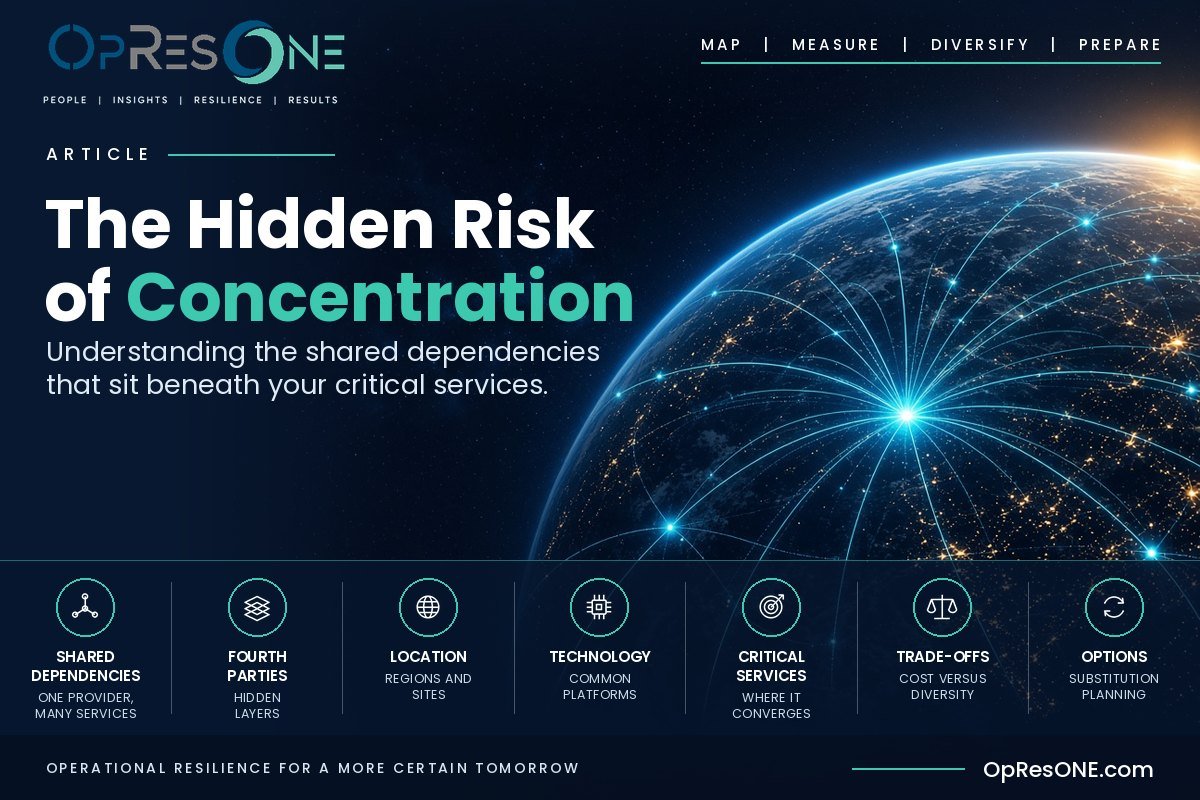
Risk registers tend to list risks one at a time. A supplier might fail. A system might go down. A site might become unavailable. Each risk is assessed, given an owner, and managed. What these lists often miss is the way dependencies overlap. When several critical services rely on the same provider, the same software platform, the same data center region, or the same small team, a single disruption does not affect one service. It affects many at once.
This is concentration risk, and it is one of the least visible exposures in modern operations. It builds gradually, through sensible individual decisions: standardizing on a leading cloud provider, consolidating vendors to reduce cost, adopting a widely used security tool, centralizing expertise in a shared service. Each decision makes sense on its own. Together, they can create a point where one failure reaches across the organization.
This brief explains how concentration risk arises, how to make it visible, and how leaders can decide what to do about it.