





 Artificial intelligence is moving rapidly from experimentation into the operating fabric of the enterprise. AI systems are influencing customer interactions, cybersecurity decisions, financial analysis, fraud detection, supply chains, software development, workforce productivity, risk management, and increasingly, decisions that once depended entirely on human judgment.
For executives, that creates extraordinary opportunity. It also creates a difficult new question.
How do you confidently understand what could happen when an AI-enabled environment behaves differently than expected, without waiting for that failure to occur in the real organization?
Traditional risk assessments can document potential threats. Governance frameworks can establish controls. Red teams can probe vulnerabilities. Tabletop exercises can challenge decision-makers. Model validation can test performance.
All remain important.
But AI introduces combinations of operational, technological, human, data, cyber, third-party, and governance risk that can be difficult to understand independently. A model does not have to stop functioning to create disruption. The model may continue operating while its outputs degrade, its underlying data changes, its dependencies fail, an attacker manipulates its inputs, or an autonomous agent takes actions outside expected parameters.
This is where the digital twin becomes strategically important.
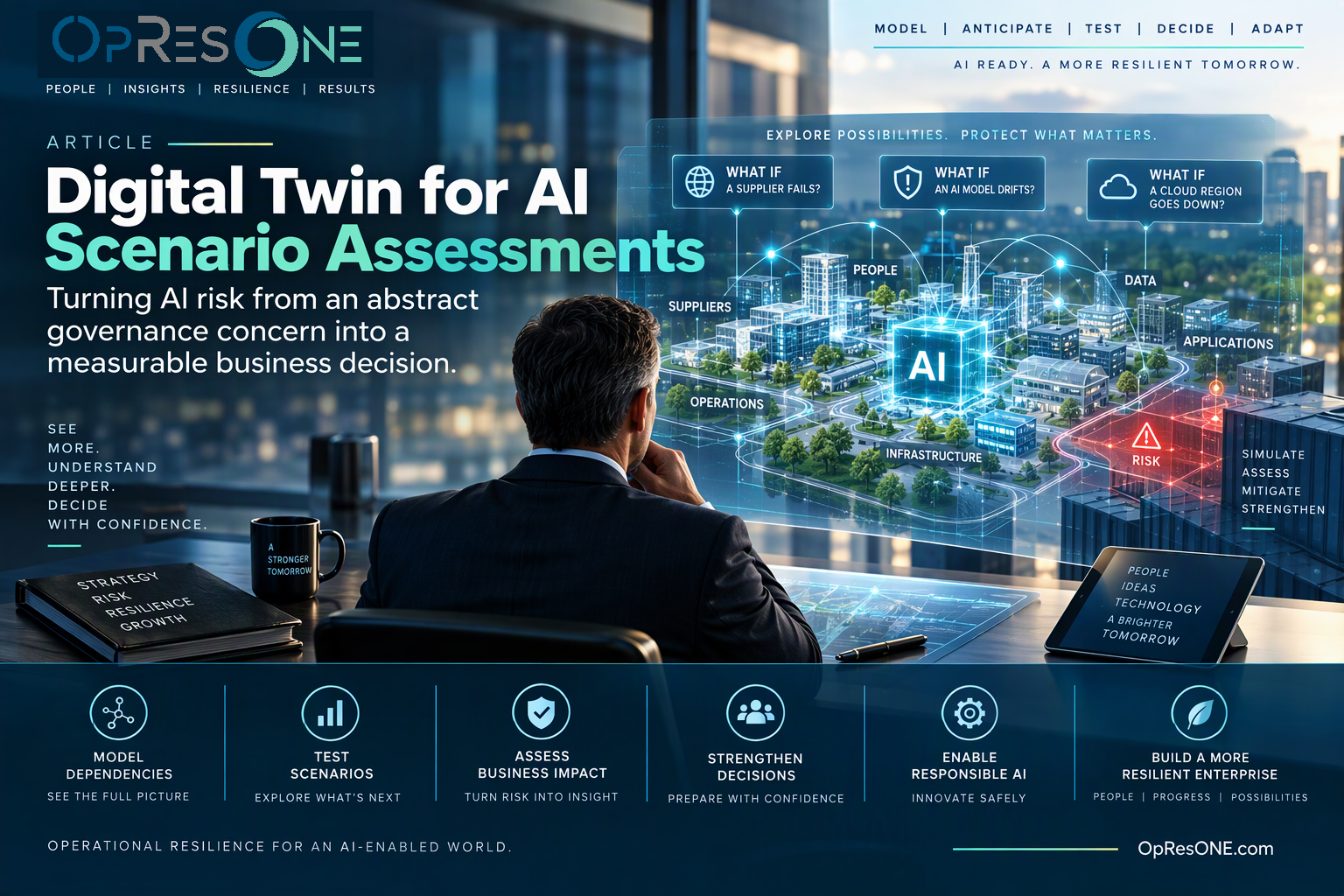
A digital twin for AI scenario assessment can provide a controlled representation of the environment in which leaders model dependencies, introduce scenarios, explore cascading effects, compare response choices, and understand potential business consequences before making decisions in the real world.
The objective is not to predict the future with certainty.
It is to make uncertainty more observable, testable, and actionable.
For executive leadership, that distinction matters.
From Digital Representation to Decision Environment
The concept of a digital twin is not new. Digital twins have long been associated with manufacturing, engineering, aerospace, infrastructure, and other environments in which a virtual representation helps organizations understand how a physical system might behave.
Enterprise AI expands the idea.
Instead of creating a virtual representation of a machine, an AI scenario digital twin can represent important elements of an interconnected business environment.
That might include business services, processes, applications, data, people, suppliers, infrastructure, security controls, AI models, AI agents, and the dependencies connecting them.
This creates something much more useful than another risk register.
Imagine a critical customer onboarding service.
At the executive level, the service appears straightforward: a customer submits information, the organization evaluates it, completes required checks, and provides a decision.
Underneath that outcome might exist dozens of dependencies.
Identity systems authenticate the customer. External providers validate information. Data services enrich the customer record. AI models evaluate risk. Fraud-detection systems identify suspicious behavior. Cloud infrastructure hosts applications. APIs connect external services. Human employees review exceptions. Regulatory controls determine whether certain decisions require additional oversight.
AI may be embedded across several stages.
A digital twin helps represent those relationships so that risk can be assessed in the context of the business service they collectively support, rather than evaluating each component in isolation.
That changes the executive conversation from:
"Is the AI model compliant?"
to:
"What happens to the business if this AI capability becomes unavailable, unreliable, compromised, or behaves in a way we did not anticipate?"
That is a far more valuable question.
AI Failure Does Not Always Look Like Technology Failure
This is one of the most important distinctions executives need to understand.
Traditional technology failures are often visible.
A server goes offline.
A network connection fails.
An application becomes unavailable.
Users cannot log in.
AI can fail differently.
The system may remain available while generating unreliable output.
A model can experience drift.
A source of data can become corrupted.
Prompt injection can manipulate an AI-enabled workflow.
A downstream model can change without the enterprise completely understanding the consequences.
An autonomous agent can have technically valid credentials but use them in an unexpected way.
A human operator can place excessive trust in generated recommendations.
The Business Continuity Institute highlighted this problem in its November 2026 discussion of AI regulation and resilience, noting that an AI failure may not resemble a conventional outage because the system can remain operational while producing degraded or unsafe outputs. (Source: BCI)
That characteristic challenges conventional continuity and disaster-recovery thinking.
If an application is unavailable, failover procedures can begin.
But what happens when the application is functioning perfectly while the intelligence guiding its decisions is wrong?
Availability alone is no longer an adequate measure of resilience.
Organizations also need to consider integrity, behavior, trustworthiness, and recoverability.
A Digital Twin Makes Dependencies Visible
The real power of digital twin scenario assessment emerges through dependency modeling.
Suppose an organization operates an AI-assisted fraud-detection service.
On the surface, leadership may primarily see:
Fraud Detection AI
But the business capability could actually depend upon:
Customer Transaction → Application → API → Identity → Transaction Data → External Data Provider → AI Model → Cloud AI Platform → Decision Engine → Human Review → Customer Action
Now introduce third parties, network services, security controls, data pipelines, privileged accounts, and monitoring capabilities.
The dependency graph becomes significantly more complicated.
This is precisely why organizations sometimes misunderstand resilience.
Individual components may each appear healthy while the overall service remains vulnerable because of relationships between those components.
A digital twin provides a mechanism for visualizing and experimenting with those relationships.
If a particular external model becomes unavailable, what services are affected?
If the primary data source becomes unreliable, which AI decisions become suspect?
If an identity provider is compromised, which agents continue to have access?
If an API begins returning incomplete information, where does the impact propagate?
The digital twin allows those questions to be explored before the organization is answering them during a crisis.
Moving Beyond the Single-Risk Scenario
Traditional scenario exercises frequently begin with a single initiating event.
A ransomware attack occurs.
A data center is unavailable.
A supplier fails.
A major application goes offline.
Real crises rarely remain that orderly.
A cyberattack can disrupt identity services. Identity disruption can prevent employees from using collaboration platforms. The crisis-management team may discover that its emergency communication platform relies on the same authentication service. A critical supplier may simultaneously be affected. Social media claims may generate customer concern before the organization has confirmed the facts.
AI introduces further complexity.
Imagine an AI-enabled customer platform experiencing an unusual increase in inaccurate decisions.
Initially, monitoring suggests model drift.
The organization attempts to revert to an earlier model.
However, the previous version depends upon a data transformation process that was retired during a recent modernization initiative.
The fallback consequently cannot operate as planned.
Meanwhile, an autonomous workflow continues processing transactions using the degraded model.
Customer complaints increase.
Regulators request information.
The organization's analysts now need to determine which decisions were affected, while operational teams need to determine whether the service should be suspended.
That is a cascading scenario.
A digital twin is particularly valuable because leaders can explore these chains rather than evaluating risks one at a time.
Scenario Assessment Becomes an Executive Laboratory
Executives do not need digital twins because they need another technology platform.
They need them because difficult decisions are safer and cheaper to explore in simulations than during actual incidents.
Think of digital twin scenario assessment as an executive laboratory for uncertainty.
Leadership can ask:
What happens if we remove this provider?
What happens if this model is unavailable for 24 hours?
What happens if the model remains available but its accuracy deteriorates materially?
What happens if two dependencies fail simultaneously?
What happens if human intervention is required for every AI decision?
What happens if an autonomous agent loses access to one system but retains privileged access to another?
What happens if transaction volume doubles during the incident?
Each scenario produces information.
That information can then influence architecture, investment, controls, continuity planning, supplier strategy, insurance decisions, executive escalation thresholds, and AI governance.
The result is not merely a better simulation.
It is better decision-making before the disruption occurs.
Connect AI Governance With Operational Resilience
Organizations should resist the temptation to treat AI governance as an entirely separate universe.
Many AI resilience questions are actually familiar business continuity, cybersecurity, technology risk, and operational resilience questions expressed in a new context.
The Business Continuity Institute has similarly argued that organizations can extend controls they already trust to AI systems and specifically connects AI governance with criticality, dependency, change management, incident response, business continuity, supply-chain security, human oversight, and recovery. (Source: BCI)
That suggests a practical architecture.
A digital twin can connect AI governance controls with the broader operational environment.
For example, a model might be governed against NIST AI RMF or an AI management system based on ISO/IEC 42001. Cybersecurity considerations may align with NIST CSF 2.0 or ISO/IEC 27001. Business continuity may align with ISO 22301. Enterprise risk may use concepts from ISO 31000.
The value comes not from stacking frameworks on top of one another.
It comes from connecting their underlying questions to the same operating environment.
Which service is critical?
What depends on AI?
What data does the AI require?
Who owns it?
What controls govern it?
Who can override it?
What happens when it fails?
What is the fallback?
How quickly can the organization recover?
What evidence shows that recovery works?
A digital twin creates a place where those relationships can become visible.
Human Oversight Must Be Tested, Not Assumed
Human oversight is frequently offered as a safeguard against AI risk.
That safeguard is only meaningful if it works operationally.
Imagine an AI process handling 50,000 decisions per day.
Under normal conditions, employees manually review one percent of those decisions.
A scenario causes the organization to temporarily suspend autonomous decision-making.
Suddenly, 50,000 decisions require manual processing.
The organization has established human oversight on paper.
But is that oversight operationally viable?
How many employees are required?
What is the maximum manual processing capacity?
How quickly will a backlog develop?
What happens to customers while they wait?
Which transactions receive priority?
How long can the business operate that way?
A digital twin can transform the phrase "human in the loop" from a governance statement into a capacity question.
That is enormously valuable for executive decision-making.
Testing AI Dependencies Before They Become Critical
Another strategic benefit involves change.
AI environments can evolve quickly.
Models are updated. Data sources change. Vendors modify platforms. Organizations introduce new integrations. Agents receive new capabilities. Business units find additional use cases.
A process that relied minimally on AI six months ago may become operationally dependent upon it today.
That means criticality should not be assessed once.
It needs to evolve alongside adoption.
Before a major AI capability is introduced into a critical service, the digital twin can model the proposed dependency.
Leadership can ask what the operating model looks like with and without the AI capability.
If adoption creates a new concentration risk, leadership can see it.
If the AI model depends upon an external platform that already supports several other services, that concentration becomes visible.
If there is no viable fallback, management can decide whether that exposure fits the organization's resilience tolerance.
This creates a fundamentally healthier approach to innovation.
Instead of resilience becoming the group that says no, resilience becomes part of determining how to say yes safely.
From Static Assessment to Continuous Intelligence
Traditional risk assessments are inherently periodic.
The assessment describes the environment at a particular moment.
Digital enterprises do not remain static.
Cloud resources change.
Suppliers change.
Applications change.
Vulnerabilities change.
Models change.
Threats change.
Data changes.
A mature digital twin should therefore evolve toward a living representation of the operating environment.
Connections to asset inventories, cybersecurity tools, configuration data, supplier systems, incident-management platforms, business continuity systems, risk platforms, and AI inventories can keep relevant portions of the model current.
Real-time or near-real-time telemetry can make scenario assessment even more valuable.
Suppose a major supplier experiences a service incident.
Instead of asking teams to manually determine where that provider is used, the organization can identify the related services and dependencies represented within the twin.
Leadership can then model possible deterioration.
What happens after two hours?
Six hours?
Twenty-four hours?
Which business tolerances are approaching?
What alternatives become necessary?
This is the progression from static risk documentation toward resilience intelligence.
Measure Business Impact, Not Just Technical Effects
A sophisticated simulation that tells executives hundreds of servers are affected is not necessarily useful.
Leadership needs to understand business consequences.
The digital twin therefore needs to connect technical and AI events to measures that executives understand.
Those might include revenue exposure, transaction volumes, customer impact, regulatory thresholds, service availability, operational backlogs, recovery requirements, staffing capacity, contractual obligations, supplier concentration, and reputational exposure.
Imagine two AI systems experiencing equivalent technical degradation.
System A supports an internal productivity tool.
System B influences real-time decisions within a critical customer service.
The technical issue may look similar.
The business consequences are dramatically different.
Scenario assessment must make that difference obvious.
The objective is not to create the most technically detailed digital representation possible.
It is to create a sufficiently accurate representation to support better business decisions.
Evidence-Based Investment Decisions
Executives constantly face competing investment requests.
Security wants additional controls.
Technology wants modernization funding.
Business continuity wants recovery improvements.
AI teams want new platforms.
Risk teams want additional monitoring.
Third-party risk wants broader supplier visibility.
Without a common decision context, each investment competes using different assumptions.
Digital twin scenarios can create that common context.
Suppose a critical AI-supported customer service has an eight-hour impact tolerance.
Simulation identifies an external model provider as a significant concentration risk.
Management could invest in a secondary provider, build an internally hosted fallback, maintain a manual process, or accept the exposure.
Each alternative has different cost and resilience characteristics.
Scenario assessment allows leadership to compare them.
The question becomes:
Which investment produces the greatest reduction in material business exposure?
That is a much stronger basis for capital allocation than fear, intuition, or compliance pressure alone.
Digital Twins Should Challenge Assumptions
A digital twin is not valuable because it produces attractive visualizations.
Its value comes from challenging assumptions safely.
A good AI scenario assessment should intentionally explore uncomfortable questions.
What if the backup fails?
What if employees cannot access the manual process?
What if the supplier fails at the same time?
What if the data cannot be trusted?
What if the model rollback does not work?
What if the event occurs during peak transaction volume?
What if leadership has only 30 minutes to decide whether to suspend the service?
What if communications systems are unavailable?
What if a critical decision must be made before forensic certainty exists?
Exercises become much more valuable when the objective is not proving that the plan works.
The objective is discovering where it does not.
Every weakness discovered within the digital environment represents an opportunity to prevent a weakness from becoming a customer-impacting event.
The Governance Question Still Matters
Simulation does not replace governance.
Organizations still need accountable ownership, defined AI inventories, risk classifications, human-oversight requirements, security controls, data governance, supplier governance, incident processes, testing standards, recovery expectations, and executive escalation criteria.
The digital twin becomes a means of connecting and testing those governance expectations against operational reality.
Executives should understand who owns the twin, which data feeds it, which assumptions influence simulations, how frequently dependencies are updated, and how scenarios are validated.
A digital twin containing inaccurate dependencies can create false confidence.
Model governance therefore applies not only to the AI systems being assessed but also to the scenario model being used to assess them.
Confidence requires transparency about assumptions and limitations.
What Executive Leadership Should Expect
A successful AI scenario assessment capability should ultimately provide executives with understandable answers to several fundamental questions.
Where does the organization depend upon AI?
Not only through obvious applications, but throughout critical business-service dependencies.
What happens if those AI capabilities fail differently than expected?
Including degraded, manipulated, unavailable, or uncontrolled behavior.
What is the maximum disruption the business can tolerate?
And does demonstrated recovery capability remain within that boundary?
Where are the concentrations?
Including shared models, cloud providers, data sources, technology platforms, identity systems, suppliers, and specialized expertise.
What alternatives exist?
Including manual processes, secondary providers, earlier model versions, alternative data sources, and degraded operating modes.
Have the alternatives actually been tested?
Because a fallback that exists only on paper is an assumption, not a capability.
Which investments would reduce the greatest business exposure?
This is where scenario assessment turns resilience information into executive action.
A Safer Way to Move Faster
Perhaps the greatest opportunity associated with digital twins for AI scenario assessment is not risk reduction.
It is confident innovation.
Organizations sometimes perceive governance and resilience as constraints on innovation. That occurs when risk management enters too late, after architectures are established and dependencies are difficult to change.
Digital twins create the opportunity to explore risk earlier.
Organizations can model new AI capabilities before connecting them deeply to production processes.
They can explore supplier concentration before entering long-term commitments.
They can test fallback strategies before replacing existing processes.
They can assess human capacity before automating critical decisions.
They can challenge architecture before migration.
They can simulate incidents before customers experience them.
That moves resilience from a defensive activity to a strategic enabler.
The organization can move faster because leadership better understands where taking risk is appropriate and where additional safeguards are necessary.
From Predicting the Future to Preparing for It
No digital twin will perfectly reproduce the enterprise.
No scenario engine can predict every cyberattack, model failure, supplier disruption, human decision, regulatory response, or unexpected interaction.
Nor should that be the objective.
The real value of a digital twin for AI scenario assessments lies elsewhere.
It helps organizations understand relationships.
It exposes hidden dependencies.
It reveals concentrations.
It tests assumptions.
It connects AI behavior with business consequences.
It allows alternative strategies to be evaluated before they are needed.
And it provides executives with something traditional risk assessments often struggle to offer: a dynamic view of how disruption could move through the enterprise.
Organizations cannot know exactly what the next AI-related disruption will look like.
But they can become much better at understanding what matters, what depends upon what, where failure could propagate, how the organization could respond, and which investments would create meaningful resilience.
That is the strategic promise of the digital twin.
Not a perfect representation of the future.
Not another dashboard.
Not another compliance exercise.
But a safer environment in which leaders can ask difficult questions, challenge assumptions, explore consequences, and make better decisions before those decisions have to be made under pressure.
For an enterprise adopting AI at scale, that capability may become increasingly important.
Because the organizations that succeed with artificial intelligence will not simply be those that deploy AI fastest.
They will be the organizations that understand how to innovate, govern, test, withstand disruption, recover, and adapt with confidence.


