





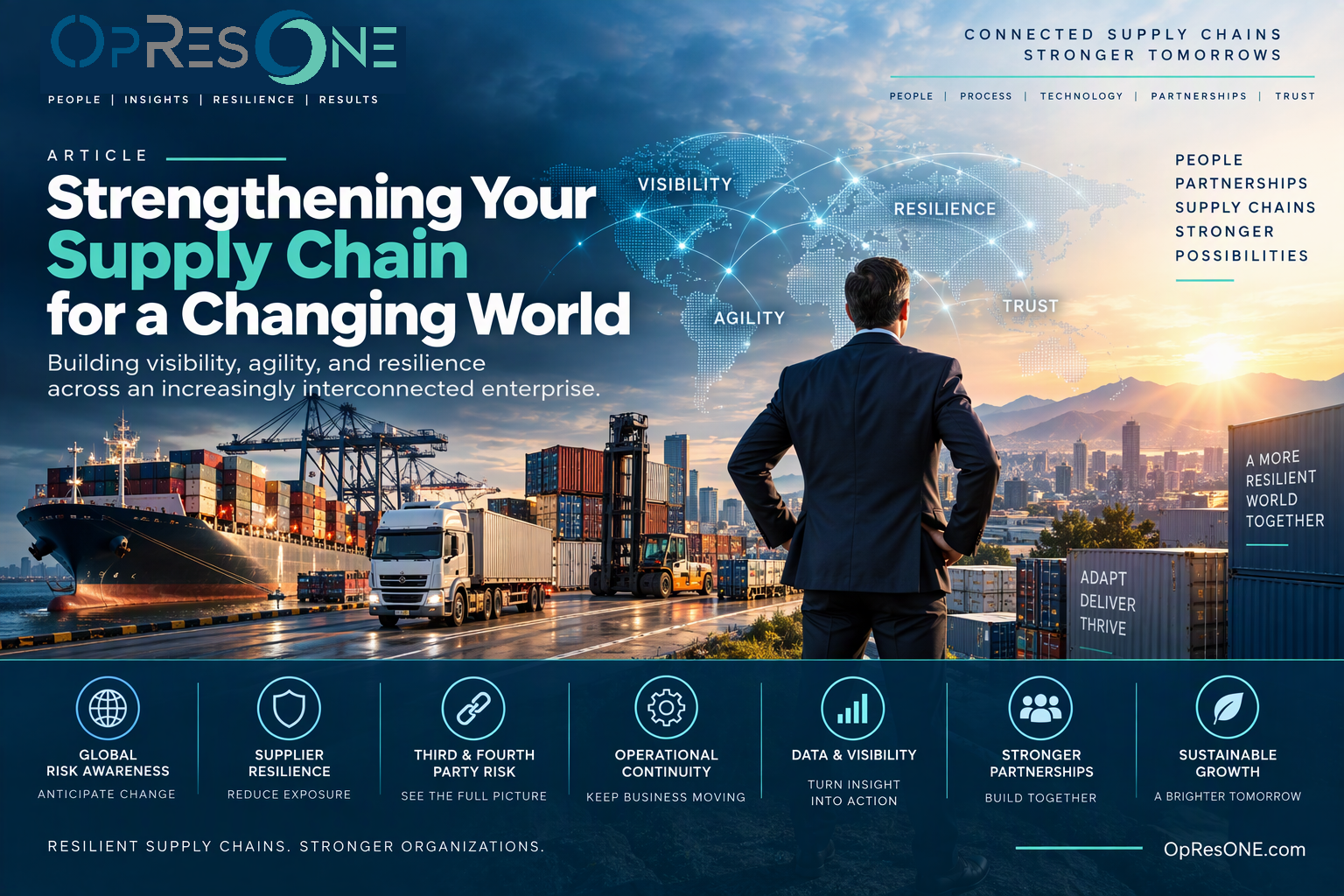
Supply chains have always faced disruption. What has changed is the speed, complexity, interconnectedness, and potential business impact of that disruption.
A supplier problem that once created a purchasing inconvenience can now interrupt production, delay customer services, expose sensitive information, disrupt critical technology, create regulatory concerns, or stop an essential business service altogether.
Global organizations depend on increasingly complex ecosystems of suppliers, manufacturers, logistics providers, cloud platforms, software companies, telecommunications providers, data processors, professional services firms, artificial intelligence providers, and fourth-party relationships. At the same time, geopolitical instability, cyberattacks, extreme weather, regulatory requirements, economic uncertainty, transportation constraints, workforce shortages, and technology concentration continue to alter the risk landscape.
Against that backdrop, supply chain management can no longer focus primarily on cost, efficiency, and availability.
Organizations must also ask:
Can our supply chain continue supporting our most important business services when disruption occurs?
That is the supply chain resilience question.
The strongest organizations will not attempt to eliminate every potential source of disruption. That is neither realistic nor economically sustainable.
Instead, they will understand what matters, identify critical dependencies, anticipate vulnerabilities, establish alternatives, continuously monitor changing conditions, and build the capacity to adapt when events do not unfold according to plan.
The goal is not an unbreakable supply chain.
The goal is a supply chain designed to bend without breaking the business.
1. The Supply Chain Has Become Part of the Enterprise
The phrase supply chain traditionally brings to mind manufacturing plants, raw materials, warehouses, trucks, ports, and distribution centers.
Those remain important.
But the modern enterprise supply chain is much larger.
A financial institution may depend on payment processors, cloud providers, credit bureaus, telecommunications carriers, fraud-detection platforms, software vendors, data providers, and managed security companies.
A healthcare organization may depend on pharmaceutical suppliers, medical device manufacturers, cloud-hosted clinical systems, laboratories, telecommunications, logistics providers, and specialized technology vendors.
A technology company may rely on cloud infrastructure, semiconductor manufacturers, development platforms, identity providers, data centers, AI models, open-source components, and outsourced engineering capabilities.
The modern supply chain is consequently both physical and digital.
For operational resilience, that distinction is critical.
An organization may operate its own buildings, employ its own workforce, and maintain resilient internal systems while remaining dependent upon an external service that represents a significant single point of failure.
Supply chain resilience must therefore become part of the wider enterprise resilience conversation.
2. Start With What Matters Most
The first mistake organizations make in strengthening supply chain resilience is attempting to treat every supplier as equally important.
They are not.
A company with several thousand suppliers cannot economically apply its highest standard of resilience analysis and testing to every relationship.
Prioritization is essential.
Instead of beginning with a vendor inventory and asking:
"Which suppliers are critical?"
start with the business and ask:
"Which products and services must we continue delivering?"
Once critical business services have been identified, organizations can trace the people, processes, technologies, data, facilities, and suppliers necessary to deliver them.
Consider a customer payment service.
Supporting dependencies could include:
Customer → Website → Identity Provider → Payment Application → Database → Cloud Provider → API → Payment Processor → Telecommunications → Settlement Network
A problem with any one of those components might affect the customer experience.
More importantly, several dependencies may sit outside the organization's direct control.
That changes the resilience conversation.
Instead of merely determining whether individual suppliers meet contractual obligations, leadership can examine whether the entire service chain remains capable of delivering the required business outcome.
3. Understand Your Critical Suppliers
Most organizations already classify suppliers according to some degree of risk or criticality.
The challenge is ensuring that classification reflects business impact, rather than procurement value alone.
A supplier with a relatively small contract could be critical if the organization cannot perform an essential function without the service.
Similarly, a multimillion-dollar supplier may be highly substitutable and therefore represent less resilience risk than its contract value suggests.
Useful criticality factors include:
- services supported;
- revenue dependent on the supplier;
- potential customer impact;
- regulatory consequences;
- data sensitivity;
- technology dependency;
- availability requirements;
- recovery requirements;
- geographic concentration;
- substitutability;
- switching time;
- cyber exposure;
- financial stability; and
- fourth-party dependencies.
This produces a more useful question than simply determining spend:
If this supplier disappeared tomorrow, what would happen to the business?
The answer tells leadership much more about resilience.
4. Look Beyond the Third Party
One of the most important developments in resilience is recognizing that third-party risk does not end with the third party.
Your suppliers have suppliers.
Those fourth parties have suppliers.
Cloud services depend upon telecommunications providers, energy, data centers, software, hardware, identity services, and other infrastructure.
Software platforms may incorporate hundreds of external libraries.
Manufacturers may depend upon specialized component suppliers located thousands of miles from the final production facility.
Consequently, organizations can appear diversified while unknowingly sharing common dependencies.
Imagine three critical providers:
Supplier A → Cloud Platform X
Supplier B → Cloud Platform X
Supplier C → Cloud Platform X
Traditional vendor management may report three independent relationships.
Operational resilience recognizes one concentration risk.
This is why dependency mapping must extend beyond the immediate contractual relationship.
5. Identify Concentration Before It Becomes a Crisis
Concentration risk can appear in many forms.
Geographic concentration
Several suppliers operate from the same region vulnerable to natural disasters, political instability, infrastructure disruption, or transportation constraints.
Technology concentration
Multiple critical services depend upon the same cloud provider, identity platform, software component, network, or data platform.
Logistics concentration
Different suppliers depend upon the same shipping route, port, carrier, warehouse, or freight provider.
Workforce concentration
Specialized operations depend upon a small pool of people or knowledge concentrated within one supplier or geography.
Fourth-party concentration
Apparently independent vendors ultimately rely upon the same downstream supplier.
Data concentration
Multiple business services depend upon one external source of essential data.
Organizations need to understand not only individual supplier risk but also aggregated exposure across suppliers.
Five individually manageable risks can combine into one material enterprise exposure.
6. Build Visibility Before Building Resilience
You cannot protect dependencies you do not understand.
Visibility is therefore the foundation of supply chain resilience.
Organizations should be able to identify, at minimum:
Critical Business Service → Process → Technology → Data → Supplier → Fourth Party → Location
The challenge is that this information rarely resides in one place.
Data may be distributed across:
- procurement systems;
- contract repositories;
- GRC platforms;
- CMDBs;
- business continuity systems;
- enterprise architecture repositories;
- cybersecurity platforms;
- accounts payable;
- supplier-management systems;
- cloud-management platforms; and
- spreadsheets maintained by individual teams.
The objective does not necessarily need to be another master database.
Organizations should instead create a connected dependency model that brings these sources together.
Once established, that model becomes incredibly valuable.
Leadership can begin answering questions such as:
Which critical services use Supplier X?
Which suppliers rely on the same cloud infrastructure?
Which critical suppliers operate in a region affected by an emerging event?
Which business services lack viable alternative suppliers?
That is the difference between supplier information and supply chain intelligence.
7. Plan for Supplier Failure, Not Just Supplier Risk
Traditional third-party risk management spends significant time determining whether a supplier is likely to fail.
Operational resilience asks an additional question:
What will we do if the supplier fails anyway?
This shift is fundamental.
Even a financially strong, well-managed, highly certified supplier can experience:
- ransomware;
- technology failure;
- natural disaster;
- geopolitical disruption;
- data corruption;
- telecommunications outage;
- cloud service interruption;
- regulatory action;
- operational error; or
- failure of an upstream provider.
Supplier assessments remain valuable, but they never eliminate uncertainty.
Organizations therefore need failure strategies.
Depending upon the service, strategies may include:
- redundant suppliers;
- alternative sourcing;
- safety stock;
- geographic diversification;
- internal fallback capability;
- manual operating procedures;
- data escrow;
- technology redundancy;
- alternative transportation;
- emergency contracting; or
- pre-negotiated capacity.
The goal is reducing the extent to which a single supplier failure becomes an enterprise crisis.
8. Understand the Difference Between an Alternative and a Viable Alternative
A backup supplier listed in a continuity plan is not necessarily a resilient solution.
Suppose a manufacturer currently purchases 100,000 units per month from its primary supplier.
The continuity plan identifies Supplier B as an alternative.
But Supplier B can provide only 15,000 additional units per month.
Technically, an alternate exists.
Operationally, it cannot replace the required capacity.
The same issue occurs with technology services.
A secondary provider may exist but require:
- 90 days to implement;
- new integrations;
- data migration;
- security approval;
- contract negotiation;
- new user training; or
- regulatory approval.
The organization should therefore evaluate alternatives according to characteristics such as:
Available capacity
Activation time
Switching cost
Technical compatibility
Data portability
Geographic independence
Shared dependencies
Contractual readiness
Operational readiness
Testing status
Resilience requires usable alternatives, not theoretical ones.
9. Cybersecurity Is Now Supply Chain Risk
The separation between cybersecurity and supplier management is disappearing.
Organizations frequently give suppliers access to:
- networks;
- applications;
- customer information;
- intellectual property;
- credentials;
- development environments;
- cloud resources; and
- operational technology.
The compromise of a supplier can therefore create a path into the enterprise.
Software supply chains create additional challenges because organizations can inherit vulnerabilities from components they did not directly develop.
Strong supplier resilience programs should consequently align with cybersecurity practices such as:
- least privilege;
- multifactor authentication;
- privileged access management;
- network segmentation;
- continuous vulnerability monitoring;
- security logging;
- incident-notification requirements;
- software component visibility;
- penetration testing where appropriate; and
- access termination controls.
A supplier relationship is not just a commercial relationship.
It may also represent part of the organization's attack surface.
10. AI Adds Another Layer of Supply Chain Dependency
Artificial intelligence is quickly becoming part of the enterprise supply chain.
Organizations increasingly consume externally provided:
- foundation models;
- AI platforms;
- copilots;
- AI agents;
- training data;
- inference services;
- APIs;
- specialized AI applications; and
- cloud AI infrastructure.
An organization may therefore depend on AI without owning the underlying model or infrastructure.
That creates new resilience questions:
- What happens if the AI service becomes unavailable?
- Can the process operate manually?
- Can another model be substituted?
- Will data move with the organization?
- Does a model change affect downstream processes?
- Who monitors the external AI provider?
- What if an AI supplier's output becomes unreliable rather than unavailable?
- Which critical services depend upon AI?
- Can those dependencies be identified quickly during an incident?
AI governance and supply chain resilience therefore need to evolve together.
11. Contracts Should Support Resilience
Supplier contracts can become important resilience controls.
Organizations should consider whether critical contracts appropriately address matters such as:
- service availability;
- recovery objectives;
- backup expectations;
- cyber incident notification;
- security requirements;
- audit rights;
- subcontractor notification;
- geographic restrictions;
- data portability;
- termination assistance;
- business continuity;
- disaster recovery testing;
- participation in exercises; and
- exit provisions.
However, contractual language alone does not create operational capability.
A contract requiring four-hour recovery provides limited value if the supplier has never demonstrated four-hour recovery.
That distinction matters.
Contractual assurance should be supported by operational evidence.
12. Test With Your Suppliers
Many organizations test internal continuity capabilities without involving the external organizations upon which those capabilities depend.
That creates a significant blind spot.
Critical suppliers should participate in resilience testing where practical.
Testing can range from relatively simple validation to integrated exercises.
Level 1: Documentation review
Confirm plans, responsibilities, contacts, and recovery commitments.
Level 2: Supplier tabletop
Talk through a disruption affecting the supplier.
Level 3: Communications test
Validate notification and escalation processes.
Level 4: Recovery evidence review
Evaluate evidence from supplier recovery testing.
Level 5: Integrated exercise
Exercise both organizations against one scenario.
Level 6: Technical or operational failover
Demonstrate that an alternate capability actually works.
Testing transforms supplier resilience from an assumption into evidence.
13. Build Exit Strategies Before You Need Them
Organizations naturally put significant effort into supplier onboarding.
Much less attention is often given to exit.
But when a strategic supplier experiences difficulty, switching can become extremely complicated.
A meaningful exit strategy should answer:
- How do we recover our data?
- In what format?
- How quickly?
- Who owns migration?
- Which replacement providers exist?
- How long would implementation take?
- What technical dependencies must change?
- How do we terminate supplier access?
- What happens to integrations?
- What regulatory approvals are necessary?
- How will customers be affected?
If leadership cannot answer those questions, the organization may be more dependent upon the supplier than executives realize.
14. Move From Periodic Assessments to Continuous Monitoring
Supplier risk can change much faster than annual reviews.
A supplier evaluated as healthy in January could experience a major cyberattack, financial deterioration, leadership disruption, regulatory investigation, or geopolitical exposure months later.
Critical supplier monitoring should therefore become increasingly continuous.
Relevant indicators may include:
- cybersecurity events;
- credit deterioration;
- financial performance;
- sanctions;
- litigation;
- regulatory action;
- geographic events;
- natural hazards;
- service incidents;
- ownership changes;
- major technology changes; and
- mergers and acquisitions.
The goal is not collecting unlimited data.
It is identifying material change early enough to act.
15. Use Scenario Analysis to Expose Weakness
Historical experience alone cannot identify every future disruption.
Organizations need to examine severe but plausible scenarios.
Examples might include:
Scenario A
Your largest logistics provider becomes unavailable for seven days.
Scenario B
A cloud region supporting multiple critical providers fails.
Scenario C
A geopolitical event eliminates access to a major supplier geography.
Scenario D
A ransomware attack compromises a critical technology provider.
Scenario E
A fourth-party telecommunications provider fails and simultaneously affects several strategic suppliers.
Scenario F
A critical AI provider produces unreliable output while remaining technically available.
For each scenario, ask:
- Which business services are affected?
- How quickly does customer impact begin?
- How long can operations continue?
- What alternatives exist?
- How quickly can those alternatives be activated?
- Who makes the decision?
- What regulatory obligations arise?
- What customer communication is required?
- What is the estimated financial exposure?
- Where does the current resilience strategy fail?
Scenarios expose interconnected weaknesses that individual supplier assessments often miss.
16. Turn Supplier Data Into Executive Intelligence
Executives do not need hundreds of pages of vendor assessments.
They need decision-oriented information.
A mature supply chain resilience dashboard might include:
- number of critical suppliers;
- critical suppliers supporting multiple important services;
- suppliers without tested recovery capability;
- single-source dependencies;
- geographic concentrations;
- shared fourth parties;
- suppliers outside established risk tolerance;
- unresolved critical findings;
- active material incidents;
- suppliers lacking viable exit strategies; and
- resilience trends.
The goal is not producing more metrics.
The goal is answering:
Where could a supplier failure materially disrupt our business, and what are we doing about it?
17. Efficiency and Resilience Are Not Opposites
For years, supply chains were optimized heavily around efficiency.
Just-in-time inventory, outsourcing, supplier consolidation, infrastructure centralization, and global sourcing generated enormous economic value.
The challenge is that efficiency sometimes removes redundancy.
Resilience does not require abandoning efficiency.
It requires understanding the trade-off.
A second supplier may increase unit costs by several percentage points while substantially reducing the financial impact of a prolonged interruption.
Additional inventory creates carrying costs but may protect a manufacturing operation against a transportation disruption.
Multi-region technology architecture costs more but can reduce exposure to regional failure.
The correct decision depends upon the value of the service being protected and the organization's tolerance for interruption.
Resilience is therefore an economic decision as much as a risk-management decision.
18. Assign Clear Business Accountability
Third-party risk cannot belong exclusively to procurement.
Procurement may negotiate the relationship.
Cybersecurity may evaluate security controls.
Legal may establish contractual protections.
Business continuity may assess recovery.
Enterprise risk may establish oversight.
Compliance may evaluate regulatory obligations.
Technology may manage integrations.
But ultimately, the business owner consuming the supplier's service must understand the dependency.
Every critical supplier relationship should therefore have accountable ownership.
That owner should understand:
- what the supplier provides;
- what critical services depend upon the supplier;
- expected recovery capability;
- outstanding risks;
- alternatives;
- exit strategy; and
- consequences of failure.
Resilience is strongest when accountability follows the business outcome.
19. Build the Supply Chain Into Crisis Management
When a critical supplier fails, the situation can rapidly become an enterprise crisis.
Crisis procedures should therefore incorporate third-party scenarios.
Organizations need predefined mechanisms for:
- supplier escalation;
- executive notification;
- technical coordination;
- customer communications;
- regulatory notification;
- legal review;
- alternative-provider activation;
- procurement escalation;
- financial assessment; and
- incident documentation.
Contact information should be current.
Decision authorities should be clear.
Alternative procedures should be accessible even if normal systems are unavailable.
The middle of a major supplier outage is not the time to determine who has authority to activate an alternate service.
20. A Practical Supply Chain Resilience Roadmap
Organizations do not need to transform their entire supplier ecosystem overnight.
A focused roadmap can generate substantial improvement.
Step 1: Identify Critical Services
Define the products and services whose prolonged disruption would create unacceptable harm.
Step 2: Map Supply Chain Dependencies
Connect services with suppliers, technologies, data, locations, and relevant fourth parties.
Step 3: Establish Criticality
Tier suppliers according to actual business impact rather than simply contract value.
Step 4: Identify Concentration
Find common suppliers, technologies, locations, infrastructure, and fourth-party dependencies.
Step 5: Define Tolerances
Determine how long critical business services can withstand supplier disruption.
Step 6: Assess Alternatives
Determine whether viable substitutes actually exist and how quickly they can be activated.
Step 7: Strengthen Contracts
Align critical agreements with recovery, testing, security, notification, data, and exit requirements.
Step 8: Test
Exercise realistic supplier-failure scenarios.
Step 9: Monitor
Continuously monitor material changes affecting critical suppliers.
Step 10: Report
Provide leadership with actionable resilience indicators and significant unresolved exposures.
Then repeat the cycle as the business and supplier ecosystem change.
The Executive Questions That Matter
Leaders can substantially improve supply chain resilience by asking ten straightforward questions:
- Which business services are most dependent upon external suppliers?
- Which suppliers could stop those services completely?
- Where do we have single-source dependencies?
- Which apparently different suppliers share the same underlying dependencies?
- How long could we operate without each critical supplier?
- Are our alternative suppliers genuinely capable of replacing the primary supplier?
- Have those alternatives been tested?
- Which critical fourth parties do we depend upon without a direct contractual relationship?
- Which emerging developments could materially change our exposure?
- What evidence demonstrates that our supply chain can withstand disruption?
Those questions shift the conversation from supplier administration toward operational resilience.
Building a Supply Chain Ready for Change
The future will not become less interconnected.
Organizations will continue adopting cloud services, artificial intelligence, automation, managed services, specialized suppliers, global partnerships, and external data.
That interconnectedness creates tremendous business opportunity.
It also means organizations increasingly depend upon capabilities they do not directly own or control.
Trying to eliminate that dependency would undermine many of the benefits of modern business.
The better strategy is to understand and manage dependency intentionally.
Know which services matter.
Know which suppliers support them.
Understand the dependencies beneath those suppliers.
Identify concentrations.
Create alternatives.
Strengthen contracts.
Continuously monitor change.
Exercise disruptions.
Measure actual capability.
And give executives evidence that enables informed decisions.
Ultimately, supply chain resilience is not about preventing every supplier from failing.
It is about ensuring that supplier failure does not automatically become business failure.
That distinction will become increasingly important as organizations navigate a world characterized by geopolitical uncertainty, cyber risk, AI adoption, economic volatility, regulatory change, climate-related events, technology concentration, and increasingly interconnected business ecosystems.
The organizations best prepared for that environment will not necessarily have the largest supplier networks, the most extensive questionnaires, or the most sophisticated procurement processes.
They will be the organizations that understand what matters, what it depends upon, where those dependencies are vulnerable, and what they will do when disruption arrives.
That is the foundation of a stronger supply chain.
And a stronger supply chain is increasingly fundamental to a more resilient enterprise.


