- +1 (602) 922-5990
-
This email address is being protected from spambots. You need JavaScript enabled to view it. - Mon - Fri 8:00a - 5:00p AZ






-

The organizations that lead in 2027 will not be those that avoid disruption. They will be those designed to absorb disruption, protect critical outcomes, recover intelligently, and adapt faster than the conditions around them change.
-
Supply chains have always faced disruption. What has changed is the speed, complexity, interconnectedness, and potential business impact of that disruption.
A supplier problem that once created a purchasing inconvenience can now interrupt production, delay customer services, expose sensitive information, disrupt critical technology, create regulatory concerns, or stop an essential business service altogether.
-
Organizations have traditionally viewed disruption as something they must prevent, withstand, and recover from. Business continuity teams prepare plans. Technology teams build recovery capabilities. Cybersecurity teams establish defenses. Risk teams monitor exposure. Executives establish crisis structures designed to protect the organization when something goes wrong.
-
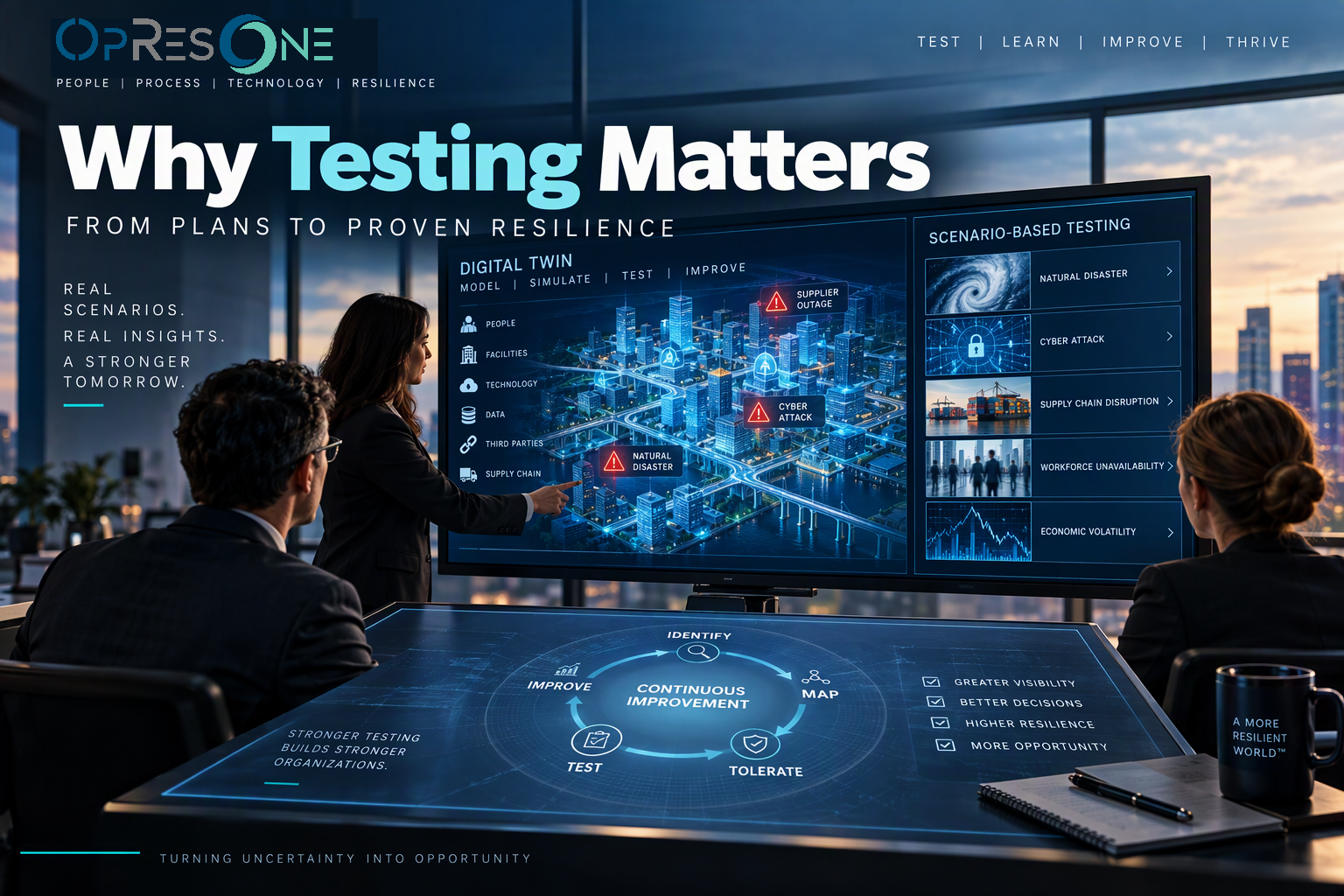
Organizations invest significant time and resources creating business continuity plans, disaster recovery procedures, cyber response playbooks, crisis management frameworks, and third-party resilience programs. Those investments are necessary. Yet there is a fundamental difference between having a plan and knowing that the organization can execute it when disruption occurs.
That difference is testing.
-
Most boards and executive teams would say their organization has governance. There is a charter, a committee calendar, a risk register, a set of policies, and a steady flow of reports. Yet when a serious disruption, a regulatory inquiry, or a failed control lands on the table, the same question tends to surface: who actually owned this decision, and how did we know it was working? Oversight that cannot answer that question is activity, not governance.
This article explains how to turn governance from a set of structures into a practical system of accountability, one where decisions have named owners, expectations are written down, and leaders can see evidence that the organization is doing what it says it does. It is written for directors, executives, and the GRC leaders who support them.
-
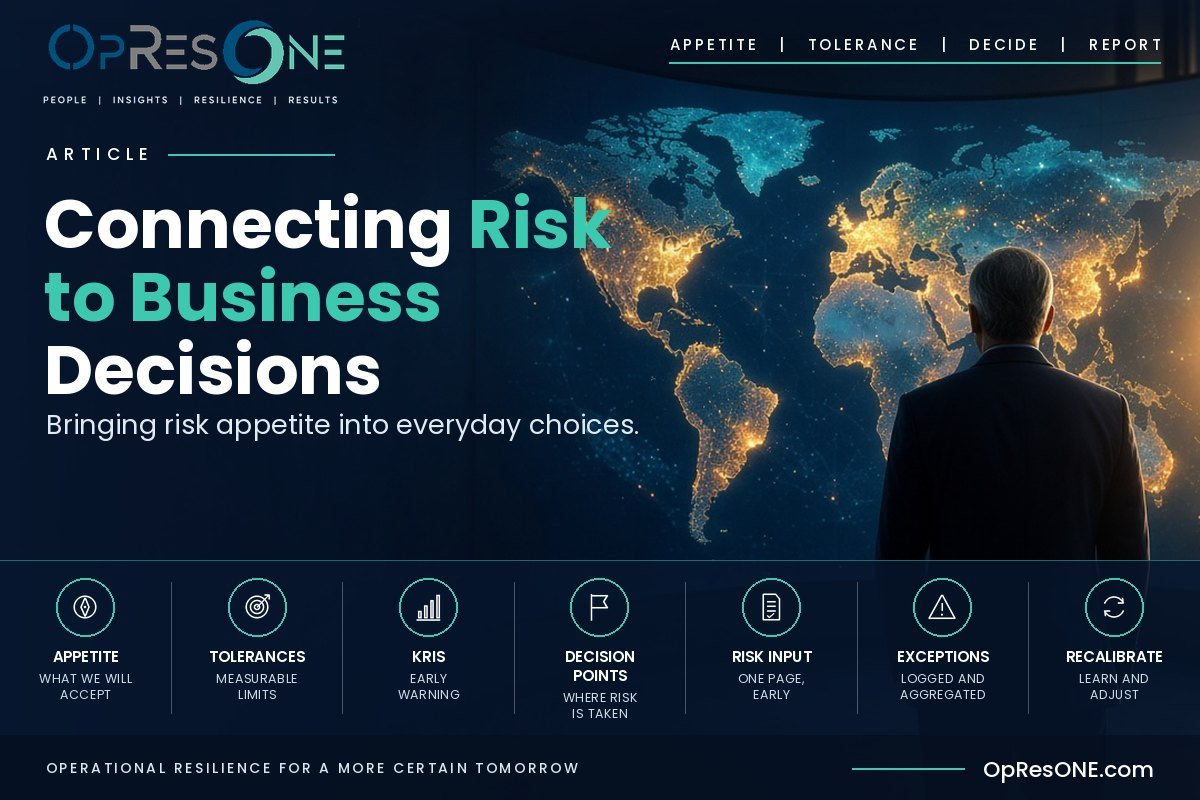
Most organizations have a risk appetite statement. Far fewer can point to a recent decision that it changed. The statement is approved by the board, filed with the risk framework, and revisited once a year, while the choices that shape the organization's risk profile, such as which projects to fund, which suppliers to use, which products to launch, and which systems to retire, are made elsewhere, on different timelines, by people who may never have read it.
This article explains how to bring risk appetite out of the framework document and into everyday business decisions. It is written for chief risk officers, executives, and GRC leaders who want risk management to inform choices before they are made, not explain them afterward.
-
For years, cybersecurity strategy has been framed largely as a contest of prevention: stronger perimeters, better detection, fewer vulnerabilities. That work remains essential. But prevention alone cannot be the whole strategy, because no organization can guarantee that every attack will be stopped. The more useful question for executives is not only "How do we keep attackers out?" but "When something gets through, can we keep delivering the services that matter most, and recover them with confidence?"
That question is the heart of cyber resilience. This article explains what it means in practice, why it requires a business-led view rather than a purely technical one, and how organizations can prepare critical services to withstand cyber disruption. It is written for CISOs, CIOs, and the executives they brief.
-
Ask an IT leader whether critical systems can be recovered and the answer is often, "Yes, we back everything up." Ask for proof and the evidence is usually a backup job report showing green checkmarks. That report confirms something useful: data was copied. It does not confirm that the business can operate again. Between a successful backup and a working business service lie restored infrastructure, rebuilt applications, reconnected integrations, validated data, and people who know how to use all of it under pressure.
This article explains why restoration alone does not prove business readiness, and how organizations can build a clear, evidence-based picture of what they can actually recover, how fast, and to what point. It is written for CIOs, IT disaster recovery professionals, and the business leaders who depend on them.
-
Every organization will face a crisis. It may arrive as a cyberattack, a severe weather event, a product failure, a supplier collapse, a safety incident, or a sudden reputational storm. What distinguishes organizations that come through well is rarely that they predicted the specific event. It is that their leaders had prepared to lead in conditions of uncertainty, with clear roles, practiced decision-making, and the information they needed to act.
Crisis readiness is an executive responsibility. This guide sets out the key considerations for building confidence before the next crisis: what makes a crisis different from an incident, what a ready leadership team looks like, and what executives can do now to prepare. It is written for chief executives, executive teams, and the directors who oversee them.
-
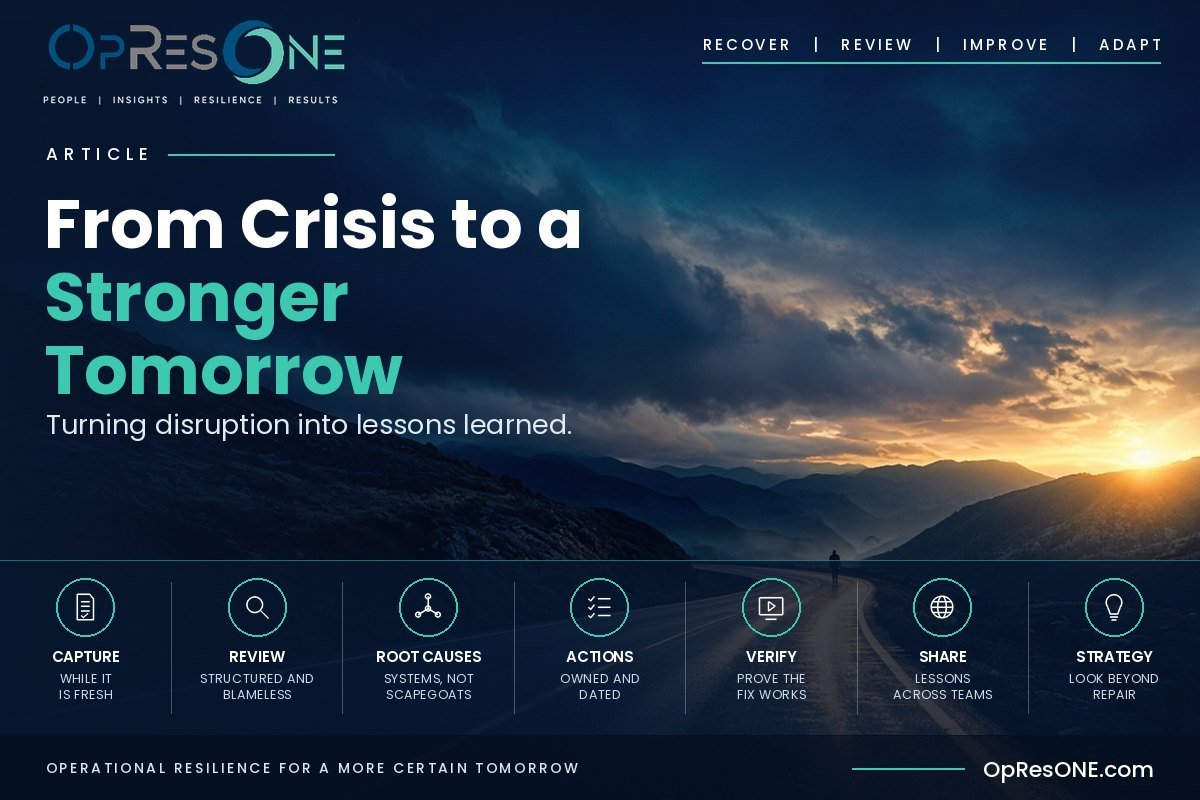
When a crisis ends, the instinct is to move on. Teams are exhausted, normal work has piled up, and leaders want to put the disruption behind them. Yet the period after a crisis is one of the most valuable an organization will have. It is the moment when weaknesses are most visible, when people are most willing to change, and when leaders have the clearest view of what truly matters to customers, employees, and the business.
Organizations that use this moment well come out stronger. They fix what failed, reinforce what worked, and make decisions that leave them better prepared for whatever comes next. This article explains how to turn disruption into lasting improvement through disciplined lessons learned. It is written for executives and the operational resilience, continuity, and crisis leaders who guide recovery.
-
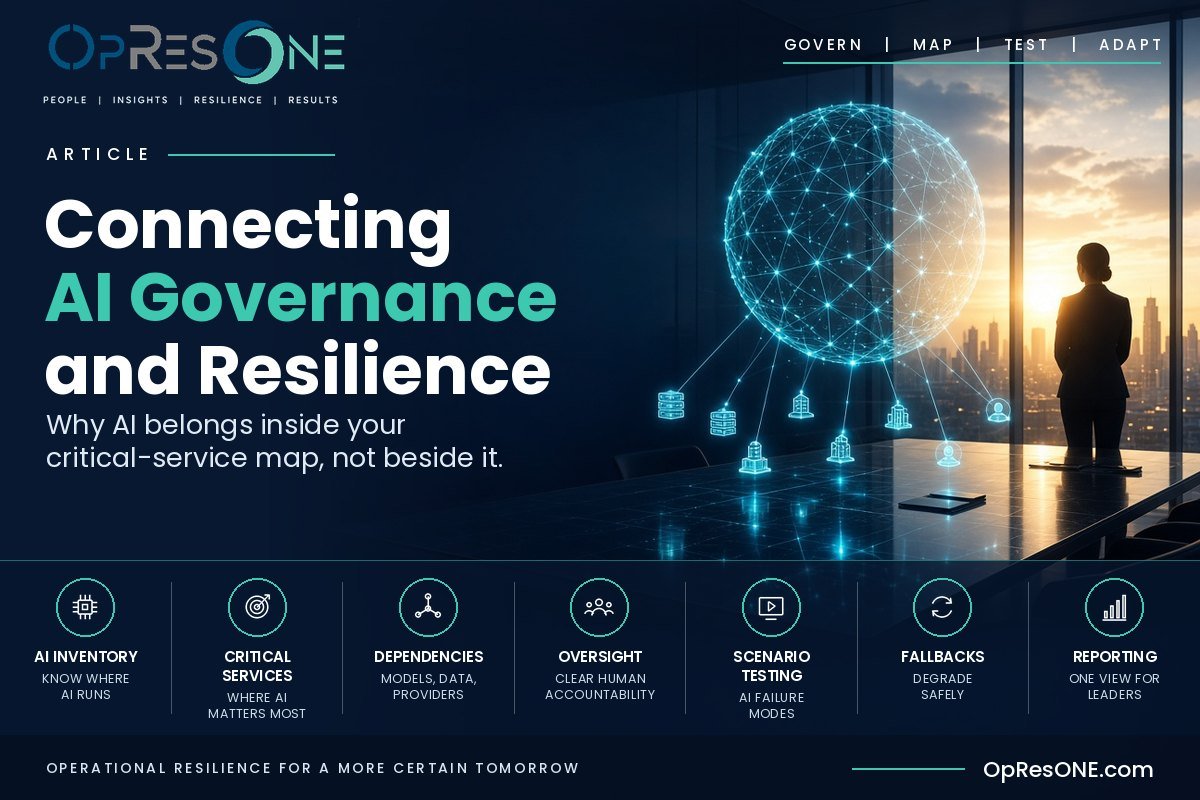
Many organizations now run two important programs side by side without connecting them. One is AI governance: the policies, committees, and risk assessments that decide how artificial intelligence may be developed, bought, and used. The other is operational resilience: the discipline of keeping critical services running through disruption. They are often staffed by different people, report to different executives, and use different vocabularies.
That separation made sense when AI sat at the edges of the business, in pilots and productivity tools. It makes less sense now that AI models help route customer calls, flag fraud, schedule maintenance, draft communications, and prioritize work queues. When AI becomes part of how a critical service is delivered, its failure becomes a resilience problem, and resilience planning that ignores it has a blind spot.
This article explains why the two disciplines need each other and how leaders can connect them without building another layer of bureaucracy.
-
Ask most organizations whether they are prepared for a serious disruption and the answer will usually point to documents: a business continuity plan, a disaster recovery runbook, a crisis communications playbook, an incident response policy. Those documents matter. They capture decisions, assign roles, and set out procedures. But a plan describes what an organization intends to do. It does not show what the organization can actually do under pressure.
The distance between those two things is the readiness gap. It is where well-written plans meet stale contact lists, untested recovery steps, suppliers that cannot meet their contractual commitments, and leaders who have never made decisions together under time pressure. Closing that gap, and being able to demonstrate that you have closed it, is what separates documented resilience from proven readiness.
This article sets out a practical way for executives and boards to move from plans to evidence, and from activity reporting to outcome measurement.
-
When a serious disruption begins, the plan is rarely the first thing that fails. More often it is the decisions around the plan. Who has the authority to shut down a system that is still serving customers? When does an operational problem become a crisis that the executive team must own? Who speaks to customers, regulators, and the media, and what are they allowed to say before the facts are confirmed? How do technology, operations, legal, and communications teams keep a shared picture when each is seeing a different part of the event?
These questions are hard to answer in the abstract and harder still at two in the morning with incomplete information. Leaders who have rehearsed them together make faster, clearer, and more defensible decisions. Leaders who have not tend to discover their gaps in real time, in front of the people they serve.
This article looks at how to rehearse leadership decision-making and cross-team coordination so that, when it matters, the organization acts as one.
-
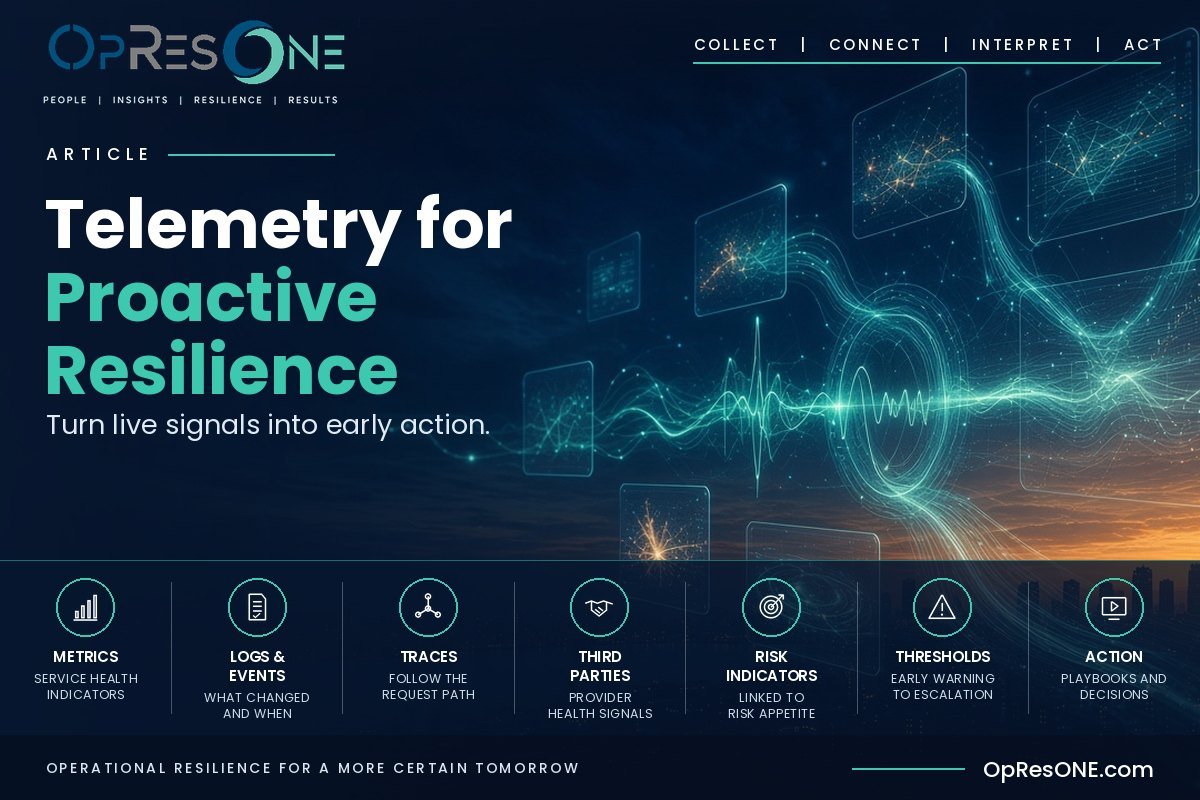
Most organizations already collect more operational data than they use. Applications write logs, infrastructure reports metrics, security tools raise alerts, cloud and SaaS providers publish service status, and business systems record every transaction. Yet when a disruption arrives, leaders often learn about it from a customer complaint, a social media post, or a call from a frustrated business unit. The signals were there. They were simply not connected to the services that matter, not interpreted in time, or not routed to someone with the authority to act.
Telemetry for proactive resilience means ingesting and analyzing real-time and near-real-time data across your environment to detect changes, identify emerging risks, and take preventive action before disruption escalates. This article explains what operational telemetry is, how to connect it to important business services and impact tolerances, and how to turn live signals into early insight that supports better decisions. It is written for operational resilience leaders, CIOs, and the risk and technology teams who support them.
-
Over the past several years, many organizations have published statements of AI principles. They commit to fairness, transparency, privacy, safety, and human oversight. These statements are a reasonable starting point. They signal intent to employees, customers, and regulators, and they give teams a shared vocabulary.
But principles do not govern anything on their own. A commitment to fairness does not tell a product team which tests to run before launching a credit model. A commitment to transparency does not say who decides what customers are told when AI is involved in a decision. A commitment to human oversight does not specify who can stop a system that is behaving badly. Between the principle and the practice sits a gap, and that gap is filled either by deliberate accountability or by assumptions.
This article explains how to turn AI principles into practical accountability that works across the full lifecycle of AI systems, from the first idea to retirement.
-
A life-sciences organization can have validated equipment, approved procedures, and a quality unit and still be unable to release a batch, complete a critical test, or keep a multi-site laboratory network running if a contract manufacturer, a specialized testing lab, a cloud laboratory system, or a model used in development or quality cannot perform. In that moment the problem is not only a supplier-management finding. It is a continuity problem, a quality problem, and, where models are in the path, an AI-governance problem.
Life sciences is not a single regulatory silo. Drug and biological product manufacturers, blood and biologics laboratories, and medical-device firms live under different Food and Drug Administration frameworks, and many also sell or operate in the European Union. This article does not treat those frameworks as interchangeable, and it does not invent client or facility examples. It asks how third-party risk and AI should be governed so that testing, manufacturing, and release can continue when a partner or a model fails.
-
Organizations want their customers, employees, regulators, and boards to trust the AI systems they use. Trust, however, cannot be requested. It has to be earned, and in a governance context it is earned through evidence: documented, verifiable information showing that an AI system was designed responsibly, tested appropriately, operates as intended, and is overseen effectively.
Many organizations have pieces of that evidence. A data science team has validation results. A vendor has supplied a technical summary. A risk team has completed an impact assessment. A monitoring dashboard tracks some performance metrics. But the pieces often sit in different places, follow different standards, and stop at the moment of deployment. When someone asks a direct question, such as "How do we know this model is still performing fairly?", assembling an answer takes weeks, if it can be done at all.
This article sets out how to connect testing, monitoring, and assurance into a continuous chain of evidence that supports trust in AI over its full life.
-
A technology firm can hold a current service-organization report, a customer contract with an uptime target, and a product roadmap for artificial intelligence, and still be unprepared for the afternoon it becomes someone else's operational incident. For many software, cloud, and SaaS companies, that is the real resilience question. The firm is not only a user of vendors. It is a third party to banks, health systems, utilities, agencies, and other businesses that have already defined the firm's platform as a critical service.
That inversion changes the work. Operational resilience is not only the firm's ability to keep its own operations running. It is the firm's ability to keep the service its customers treat as essential available, recoverable, and understandable when a subprocessor, a region, or a model fails. Third-party risk runs in both directions: the firm must manage its own suppliers, and it must be able to show customers, and in some cases supervisors, that it can be managed as a supplier. AI governance is part of the same promise whenever a model sits in the product or in the pipeline that keeps the product running.
-
Most organizations have a process for vetting suppliers. Before signing a contract, a provider completes a questionnaire, submits policies and certificates, and perhaps shares a summary of its business continuity plan. Procurement and risk teams review the responses, score the provider, and file the results. The relationship begins, and the file is revisited at renewal.
That process has value. It screens out providers with obvious weaknesses and creates a record of what was promised. But it rarely answers the question that matters most when a critical provider is disrupted: can this provider actually keep delivering, or recover quickly enough, to keep our critical services within acceptable limits? A questionnaire records what a provider says it can do. Resilience depends on what it can demonstrate.
This article explains how to move beyond paper-based due diligence toward evidence that critical providers can withstand and recover from disruption.
-
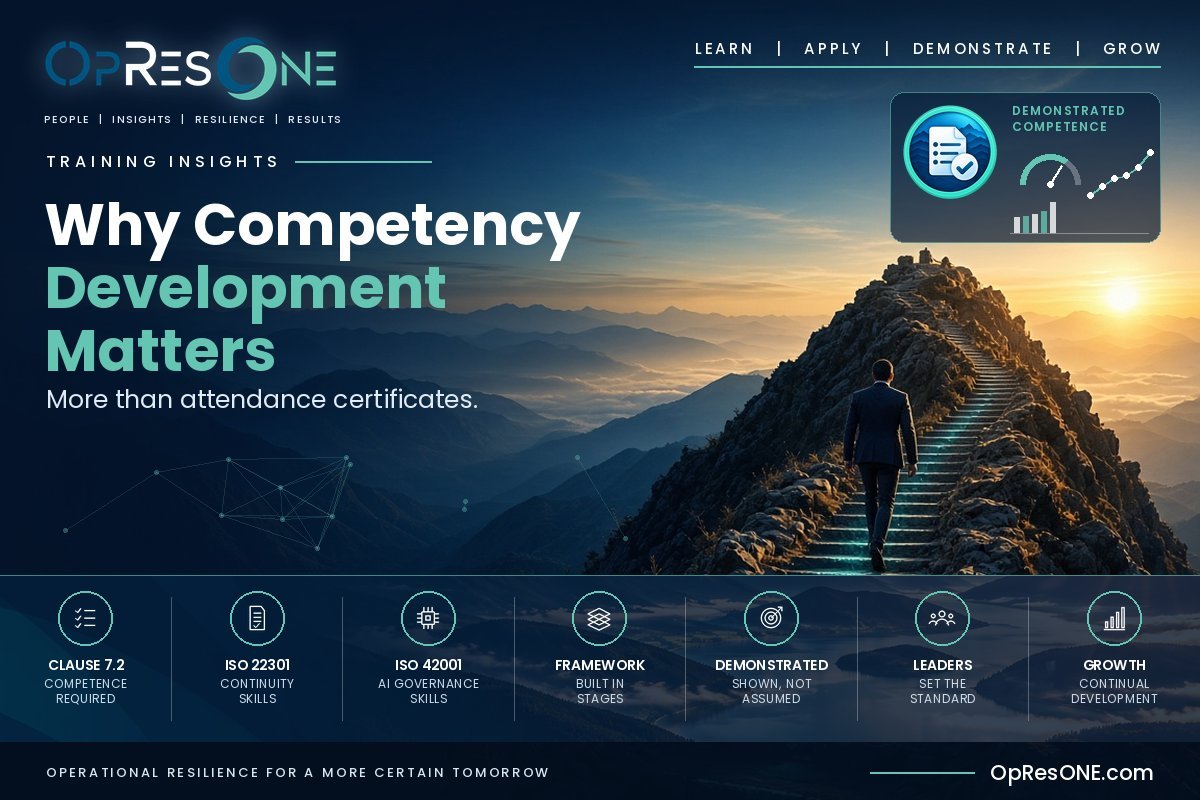
Many organizations can produce a list of courses people have attended. Fewer can show that the people who run business continuity, operational resilience or AI governance can actually do the work those systems require. Attendance is not competence. Management system standards treat that distinction as a requirement, not as a training preference.
This article explains why competency development matters, what ISO 22301:2019 and ISO/IEC 42001:2023 require in clause 7.2, how a simple competency framework helps, and how to move beyond attendance certificates to demonstrated competence. It paraphrases the published requirements; audit interpretations should be made against a licensed copy of each standard. OpResONE has no affiliation with ISO, and this article is not an official interpretation of the standards.